21/07/13
This was the second and final performance of this duet of concert Capriccios at the ROH. To read a fuller review of the first night, click here.
Renée Fleming gave a more controlled performance this second night, with far less scooping, and there were no moments of dodgy sound production (there were a couple of small cracks on the first night). It was overall a slightly smaller scale performance, but in the final scene she was even more captivating than on the first night, getting rid of quite a lot of the forced theatrics, presenting it this time as a single dramatic and emotional arc, pain and beauty merging with obvious personal significance. Great to witness.
Gerhaher ironed out the little problems with text and lack of familiarity that he had had on the first night, again delivering a superb performance. His Olivier is moody, and even angry at times, and I have to say that this interpretation is one followed by directors quite a lot, with Flamand being the easy going, more romantic suitor. So many productions of Capriccio seem to have the Countess slightly (or more than slightly) favouring Flamand, and there is endless discussion in articles about the opera about whether that gorgeous final scene contains clues as to Strauss' preference (e.g. the banality of the final words compared to the sublimity of the music). The articles miss the point of the ambiguous ending I think, and directors who fail to make Olivier as attractive as Flamand as a character weaken the ending. The message of the piece is for me somewhat distorted if one is clearly more appealing to Madeleine than the other.
Unfortunately Andrew Staples was sounding a little hoarse on the second night, though he still sang well despite this. Peter Rose didn't seem to tire at all as La Roche, giving an even more impressive account of his monologue than the previous evening, and Bo Skovhus too seemed musically more in his stride as the Count. Everyone else sang well. The orchestra were a little more on top of the score this evening, but some of the magical sparkle of the first night was missing. Still, had I not heard Davis with the ROH Orchestra on the first night, I would have been very pleased with this performance.
I mentioned a significant cut in my first night review, but were there other small cuts? I don't remember hearing mention of who gets to be the tenor in the piece (though La Roche still gets his line about being the basso buffo), but I'm always reticent to say for sure on these things, because I may just have missed it because my attention was on the orchestra or something.
Showing posts with label Capriccio. Show all posts
Showing posts with label Capriccio. Show all posts
Wednesday, 24 July 2013

Saturday, 20 July 2013
Capriccio at the Royal Opera House with Renée Fleming
19/07/13
What a gift. I was beginning to wonder whether Strauss' final and most perfect opera Capriccio simply was too rarely put on and too demanding in live performance for it to be likely that I'd ever see a really good one, but this was great. I was astonished to discover that the ROH has staged the opera fully only once - that was in 1991 with Kiri Te Kanawa. (In 1953 the Bavarian state opera came with a visiting production). This evening was a "concert performance" but it verged heavily towards "semi-staged" - Fleming and Skovhus, both of whom have done the opera many times, sang without music, and there was plenty of moving around and interaction from everyone. In fact it was an object lesson in how little has to happen for an opera to feel like it is being dramatically (rather than just musically) realised. It's probably my favourite opera so it's hard to be objective about how effective the set up was, but its cherished status for me means that it's also easy to be critical and I must say I was riveted and entertained throughout, which is more than I can say for some productions I've seen of the piece. How revealing to have Strauss' music for stage and scenery, with much of the action in the minds eye. Strauss gives us it all in his wondrous score which (as with all his operas) is so rich and detailed that it actually can become a challenge to stage.
The ROH used their "Royal Festival Hall" concert shell, with the orchestra on stage, the singers in front, and conductor Andrew Davis amongst the singers, a considerable distance from the orchestral musicians (many of whom weren't facing him as a result.) The concert shell does wonders for the ROH acoustic, at least for the front stalls where the sound can be poorly balanced and muffled. The ROH orchestra with Davis made for an interesting comparison with the Wiener Staatsoper orchestra (ostensibly the Vienna Philharmonic) and Christoph Eschenbach who I saw doing the piece last month (also with Fleming - see my review here). Individually, the playing of the ROH orchestra was sometimes questionable - the opening string sextet had some ropey moments (the offstage sextet sounded magnificent though!) and the gorgeous horn solo that introduces the famous final scene was hesitant and contained at least one crack - but overall this was by far the more convincing performance. The orchestral sonorities were more beautifully and warmly achieved, the underlying flow and momentum that links the fragmentary orchestral writing more convincing here, and the chiaroscuro contrasts of texture were more ably handled by Davis and his orchestra. Davis has a superb measure of the score, and conducts it with obvious love and affection - there were things in the orchestration that I'd never noticed before, and the vocal octets were more brilliantly performed than I have ever heard them before. The pacing always felt right and throughout the words were fully understandable from all - all in all then a superb ensemble achievement, niggles aside.
Renée Fleming did some wonderful things as the Countess Madeleine, proving she still has the goods when it counts. In Vienna last month she sang much better than she did here however - the line was firmer and purer, the text not so exaggerated. It is a common criticism of Fleming that she overinflects the text, and uses expressive portamentos to excess. As a Fleming fan (to put it mildly), these things have never bothered me in the past because the legato is so utterly flawless and in such perfect equipoise with the diction, the basic sound extremely firm and well supported, the phrasing pliant and sensitive, and the text so beautifully coloured by the voice. It's a voice I know supremely well, and here, I sadly felt that she was overcompensating for a slight loss of control that must be disconcerting for her - the scoops were often very extreme, even becoming yelps at times, especially in the more conversational moments where the line is harder to maintain, and sometimes the word stresses became so emphatic that the line was distorted. But then she'd whip out the trademark legato for one of the extended arioso moments and we'd hear the Fleming that we know and love from her recordings. In the final scene, she came on "dressed for dinner" in her Vivienne Westwood sequinned gown, now with a massive gold and silver overcoat, and we got her best singing of the evening - the huge dramatic outpourings which follow the recapitulated sonnet soared with powerful abandon, and the floating pianissimos of her final few phrases were magically dispatched. Fleming can be a very moving actress, but left to her own devices without a director her acting here felt unfocussed and even hammy - lots of pouting, posing questioningly with the sonnet, arm shaking, and the like. Again, she was at her most moving when she opted to do less, simply letting the music flow through her and naturally illuminate her expressions.
Christian Gerhaher was an almost perfect Olivier - I simply cannot think of a currently active singer who could be more ideal for this role. His precision and extraordinary way with the text is totally fitting for the character, but the beautifully balanced timbre and wonderful legato mean that Strauss' music is also fully served. It's a much bigger voice than I remember hearing when he did Wolfram in Tannhauser here back in 2010. Bizarrely and almost amusingly he totally muddled up the words for the sonnet when he was addressing Fleming in plain speech, but even before he went wrong, I thought his delivery of this spoken text wasn't quite heartfelt enough - the only weak part of an otherwise superb vocal assumption of the role. His head was mostly quite buried in the score, so I wonder if this was his first performance of the part?
Andrew Staples, standing in for an indisposed Joseph Kaiser, made an excellent Flamand. His pointing of the text was not quite as nuanced or touching as Gerhaher's but his vocal contribution never felt out of place next to his stellar colleagues, and his beautiful scene in praise of Madeleine was sung with Mozartian clarity and refinement but with Straussian surge when the music asked for it. The timbre is not the most distinctive, or at least not yet, but it is nevertheless very pleasing. A very fine showing for a very fine young singer. Peter Rose was an equally excellent La Roche. It's not the biggest or juiciest bass voice, but his German is excellent, he "gets" the role fully, is funny without buffoonery, and his legato is very good. He seemed to tire a bit towards the end of his climactic speech, but this was another very pleasing performance.
Christine Rice was in such beautiful voice in her recent Minotaur appearances that I was quite sad about her having to cancel these performances of Clairon due to a quite serious illness. I hope she gets better very soon. Her replacement Tanja Ariane Baumgartner made more of this role musically than one might have expected in what is traditionally seen as an actress's role (Strauss makes sure she could never musically upstage his heroine, just as he had with Zdenka/Arabella a decade before). She has a dark coloured mezzo voice that contrasted very nicely with Fleming's silvery soprano, and meant they were never "in competition" as sometimes can seem the case. Bo Skovhus sounded better here than he had in Vienna, less gruff and with a fuller tone, and though arguably the role doesn't require, or even shouldn't be cast with a beautiful voice, the voice is sounding quite hardened and monochrome at this stage, and Skovhus was never the most finessed singer. That said, this wasn't a bad performance, certainly not a disservice to the role. Barry Banks and Mary Plazas made a good pair of Italian singers, Banks being particularly impressive. The female singer is almost always cast with a very light voice, as here, and I never quite know why, because the first entry sits very low for a long time, and the coloratura requirements are hardly demanding.
There's a small but painful cut which the ROH, Vienna and the Met all practise, coming just before the Count suggests his brilliant solution to the other characters' quandary as to what subject to make into an opera. It always jars, because the Counts suggestion simply comes out of the air, and not from the discussion, and so seems out of character for such a professed opera sceptic. Am I the only one that misses this part? Probably.
All in all, a very satisfying evening and a wonderful close to the ROH season. I will (obviously) be at the next performance as well, so will report back on that if I have more to say.
Sunday, 23 June 2013
Capriccio at Wiener Staatsoper with Renée Fleming
20/06/13
Vienna State Opera

[NOTE: if you're looking for the 2013 ROH Capriccio with Fleming, look here.]
Strauss' final opera Capriccio, the piece for which my blog is named, almost means too much for me to give an overview of why I value it so highly. The temptation would be to list every detail, every felicity, so when I have more time I will write up my thoughts into a coherent structure - since there are a couple of ROH performances coming up, that will provide a good deadline. For the time being, suffice it to say that this piece represents an exquisite final flowering of Strauss' operatic career, an unexpected return to the brilliance of the Salome - Elektra - Rosenkavalier - Ariadne period after approximately two decades of relative mediocrity (the best bits of Arabella and Daphne being the principle highlights that soar beyond the meticulous humdrum of most of his work from the 1920s and 30s). It ushers Strauss' late harvest of works of which the Four Last Songs are the most famous and celebrated and is every bit as recherché and exquisitely crafted as the songs.


This was a frustrating show because it was almost so good in every way. First, let's consider the design. From the photos above you'd be forgiven for thinking that this was one of the most visually alluring productions you're ever likely to see, and it certainly has its moments. Visually this show is best when the lighting is very focussed on the singers bringing them into heightened, luminous focus (as in the photos above, and a few others here), and I love the idea of a Capriccio in slightly surreal, glimmering half lights, as its so different from what I hold in my minds eye when I listen to the work. However this only happens occasionally, and all too often the singers and set are covered in a haze of blues, lilacs, oranges, yellows and pinks, and there are just too many colours and textures for the aesthetic to properly congeal, let alone be stylish. The last scene for instance, contrary to the neon beauty of the photo above, has much of its stark luminescence vitiated by very diffuse gels on the lights that nullify the intense colour, and do no favours to the set. We'll see how it looks on camera* as shows can look very different on the little/big screen to how they look in the theatre.

Second, the direction. The main set components of Marco Arturo Marelli's production (he designed, directed and lit it) are a series of large triangular columns that each have three different faces representing three different levels of reality in the show. The visual effect is sometimes similar to Herbert Wernicke's Der Rosenkavalier. The stage opens on 1940's attired Flamand and Olivier (composer and poet) at their respective writing desks either side of the stage behind a gauze which blends smoothly from a chaos of notes to a chaos of words. Throughout the show this layer occasionally pops up but is not much developed. The principle action appears in a very stylised late 18th century setting and is presumably the opera that these two artists are constructing. But by teasing apart these layers that are implicit in the piece without providing obvious insights that this rending apart has opened us up to, it spoils something of this work's enigmatic unity, that special smiling glow and wistful humour that informs every bar of the score and text. Capriccio exists as a conversation piece on the nature of opera, a charming "period" romance set in an aristocratic salon, and simultaneously serves as its own explanation and deconstruction. The characters are both metaphors for the debate being enacted, archtypes, and detailed, living, believable people, whose complex desires and relationships drive the plot. It's all so artfully and effortlessly achieved that no further clarification is required: the piece itself is literally and metaphorically its own best explanation and it does it with a simple smiling elegance that it would be virtually impossible to improve upon. Marco Arturo Marelli writes with obvious love and understanding in his programme note, but he hasn't been brave enough with his vision.
This revival was very obviously very under-rehearsed. Although many of the singers from the début 2008 cast remain, they can't be expected to remember every detail in an opera as conversationally fleet footed and detailed as this without extensively re-engaging with the text, motivations and actions of the characters in this production again. It wasn't entirely clear from the booklet whether Marelli was back for this revival, but either way verbal queues were constantly missed and actions were often vague and indecisive. When Madeleine says "Fasst mich nicht an!", Olivier hadn't yet touched her, but then he awkwardly remembered he should have, and quickly grabbed her and then immediately lets go. Madeleine is meant to demonstrate the Rameau excerpt at the keyboard, but Fleming didn't get there in time, and just joined in with the offstage harpsichord way after the music has started. These are small things, but over an evening amount to a larger feeling of malaise that the singers are merely "walking through" the parts - often it seems unclear what characters actually mean by their words because their actions are ambiguous and approximate. The wonderful scenes where Olivier and Flamand declare their love were not convincing for this reason, and references to offstage action were also strangely glossed over or ignored in the acting. It's really not all bad though, characters do what they're meant to, it's not static, and there are nice touches also - the house lights going up a little when the characters all start talking about how strange opera is, adressing the audience all the while, and Olivier's cry of "Gondola, gondola!" when discussing Italian singing in the first scene, is picked up on later when the Italian Singers' duet is presented with them being carried about in gondolas. Olivier and Flamand, two sides of the same coin, wear mirror image costumes.
 As I've said before, Renée Fleming is in my opinion the greatest soprano of the age, and when the prime was so effortlessly, ravishingly flawless, the autumn of the career comes all the more painfully. However, having seen her perform (a ridiculous) eight times last year, I can confidently say that this was by some distance the best I have seen her since I started blogging, a gratefully heard return to form. Although the timbre doesn't have the same glistening radiance that it used to, here the legato and exceptional support of the line recalled the glory days of "The Beautiful Voice", and in the all important final scene, the voice soared just as one might have hoped. Amazingly, from my seat Fleming's voice sounded larger than most of her colleagues (equalled only by Kurt Rydl), giving far more tone than I have heard her give for a long time. The textual acuity is remarkable as ever. Madeleine's tessitura sits higher than the Marschallin, but lower than Arabella, and may be her best role at this stage. Despite occasional lapses in specificity in her acting, she was the only singer to overall give a rounded and dynamic acting performance in her role perhaps because she has sung her role more often than her peers (?) but her elegance and humour and occasionally bratty playfulness all made for an engaging assumption of the part.


Curtain calls:


Production photos (c) Wiener Staatsoper / Michael Pöhn
Vienna State Opera

Strauss' final opera Capriccio, the piece for which my blog is named, almost means too much for me to give an overview of why I value it so highly. The temptation would be to list every detail, every felicity, so when I have more time I will write up my thoughts into a coherent structure - since there are a couple of ROH performances coming up, that will provide a good deadline. For the time being, suffice it to say that this piece represents an exquisite final flowering of Strauss' operatic career, an unexpected return to the brilliance of the Salome - Elektra - Rosenkavalier - Ariadne period after approximately two decades of relative mediocrity (the best bits of Arabella and Daphne being the principle highlights that soar beyond the meticulous humdrum of most of his work from the 1920s and 30s). It ushers Strauss' late harvest of works of which the Four Last Songs are the most famous and celebrated and is every bit as recherché and exquisitely crafted as the songs.


 |
| this sort of thing is closer to the production's norm. |
 |
| these three as well. Lots of lovely things individually, but a mishmash overall, and often not well lit. |
 |

This revival was very obviously very under-rehearsed. Although many of the singers from the début 2008 cast remain, they can't be expected to remember every detail in an opera as conversationally fleet footed and detailed as this without extensively re-engaging with the text, motivations and actions of the characters in this production again. It wasn't entirely clear from the booklet whether Marelli was back for this revival, but either way verbal queues were constantly missed and actions were often vague and indecisive. When Madeleine says "Fasst mich nicht an!", Olivier hadn't yet touched her, but then he awkwardly remembered he should have, and quickly grabbed her and then immediately lets go. Madeleine is meant to demonstrate the Rameau excerpt at the keyboard, but Fleming didn't get there in time, and just joined in with the offstage harpsichord way after the music has started. These are small things, but over an evening amount to a larger feeling of malaise that the singers are merely "walking through" the parts - often it seems unclear what characters actually mean by their words because their actions are ambiguous and approximate. The wonderful scenes where Olivier and Flamand declare their love were not convincing for this reason, and references to offstage action were also strangely glossed over or ignored in the acting. It's really not all bad though, characters do what they're meant to, it's not static, and there are nice touches also - the house lights going up a little when the characters all start talking about how strange opera is, adressing the audience all the while, and Olivier's cry of "Gondola, gondola!" when discussing Italian singing in the first scene, is picked up on later when the Italian Singers' duet is presented with them being carried about in gondolas. Olivier and Flamand, two sides of the same coin, wear mirror image costumes.
 As I've said before, Renée Fleming is in my opinion the greatest soprano of the age, and when the prime was so effortlessly, ravishingly flawless, the autumn of the career comes all the more painfully. However, having seen her perform (a ridiculous) eight times last year, I can confidently say that this was by some distance the best I have seen her since I started blogging, a gratefully heard return to form. Although the timbre doesn't have the same glistening radiance that it used to, here the legato and exceptional support of the line recalled the glory days of "The Beautiful Voice", and in the all important final scene, the voice soared just as one might have hoped. Amazingly, from my seat Fleming's voice sounded larger than most of her colleagues (equalled only by Kurt Rydl), giving far more tone than I have heard her give for a long time. The textual acuity is remarkable as ever. Madeleine's tessitura sits higher than the Marschallin, but lower than Arabella, and may be her best role at this stage. Despite occasional lapses in specificity in her acting, she was the only singer to overall give a rounded and dynamic acting performance in her role perhaps because she has sung her role more often than her peers (?) but her elegance and humour and occasionally bratty playfulness all made for an engaging assumption of the part.
The rest of the cast were servicable, but noticeably not of world class standard, and for Capriccio to succeed it manifestly can not just be a star vehicle. Diction wise, I could only consistently understand Fleming, ironic since she is the only non native speaker apart from Skovhus, but it seems that the old singer's cliché that native speakers are usually more lazy with diction when singing in their own language is true. The role of Clairon is vocally a breeze for Angelika Kirchschlager but above all this is an actress's part and she made a curiously frumpy and charmless personality on stage. Part of it was her unflattering costuming, but she kept doing this thing where she'd reveal her trousered legs under her dress and it wasn't obvious whether this was meant to be a dramatic flourish or a sign of nervousness. This production makes her haughty and derisive, but there's got to be the inbuilt charisma to get away with the ill humour. Michael Schade and and Markus Eiche were vocally acceptable as Flamand and Olivier respectively, though were both a bit too much boyish swagger without offering the characters' sensitive vulnerability and charm. Bo Skovhus is hardly the most opulent voice, but was quite likeable as the playful count. Kurt Rydl's rather quizzical, sad La Roche laments the death of Bel Canto, sadly quite ironically here since the voice lacks anything resembling line these days, every phrase broken into individual words.
In the pit, Christoph Eschenbach astonishingly makes his Vienna State Opera début. It was not quite the perfect Capriccio I was expecting based on previous experiences of his conducting of the final scene, which must be ranked as the most gloriously beautiful and understanding of our time (thankfully enshrined on CD with the Vienna philharmonic on Fleming's Strauss Heroines disc.) The singers were never covered, and were followed and supported with great accuracy, and the orchestra was dazzlingly precise in its fragments of melody, but the sense of the longer line wasn't achieved until quite a while in. Since I was near the front, perhaps the sound wasn't ideal - I'd be fascinated to hear how it sounded higher up in the house where the sound it better. The final scene was as wonderful as ever though.
Overall I enjoyed this, and found it worthwhile despite its flaws.

*This production is being filmed for DVD (EDIT: though there were doubts about whether this was going to be released, it is, very soon!) which means, extraordinarily enough, that we will have three Fleming Capriccios on DVD. The Carsen 2004 production with Fleming in her peak voice is still the one to have as overall as it is the best directed, has the best supporting cast, and is the most visually beautiful. The Met DVD of the abominably drab Cox production which is the one wheeled out in most English speaking nations (in 20s/30s or "period" dress) finds Fleming at her most affected dramatically, a none too exciting cast, and of course the Met's horrible video direction (review here). The Marelli production is decent, but Oh how I wish we could have had the 2008 première when the cast were all newly rehearsed, and Fleming was in her prime. However, we can't have everything, and must be thankful that we are having it at all. Hopefully, over the next two evenings, the cast will hit their marks more often and they'll be able to patch together a convincing realisation of the staging. Also perhaps close-ups will help make the thing feel less "bitty". It will broadcast live on the internet on 27th June 2013.In the pit, Christoph Eschenbach astonishingly makes his Vienna State Opera début. It was not quite the perfect Capriccio I was expecting based on previous experiences of his conducting of the final scene, which must be ranked as the most gloriously beautiful and understanding of our time (thankfully enshrined on CD with the Vienna philharmonic on Fleming's Strauss Heroines disc.) The singers were never covered, and were followed and supported with great accuracy, and the orchestra was dazzlingly precise in its fragments of melody, but the sense of the longer line wasn't achieved until quite a while in. Since I was near the front, perhaps the sound wasn't ideal - I'd be fascinated to hear how it sounded higher up in the house where the sound it better. The final scene was as wonderful as ever though.
Overall I enjoyed this, and found it worthwhile despite its flaws.


 |
| this is the leg thing she kept doing |
 |
| looked throughout like John Malkovitch in Dangerous Liaisons |
 |
| The 1940's dress |


Production photos (c) Wiener Staatsoper / Michael Pöhn
Tuesday, 13 November 2012
CD Review: Isokoski sings Strauss
Ondine
Soile Isokoski
3 Hymns - Opera Arias Helsinki Philharmonic Orchestra, Okko Kamu
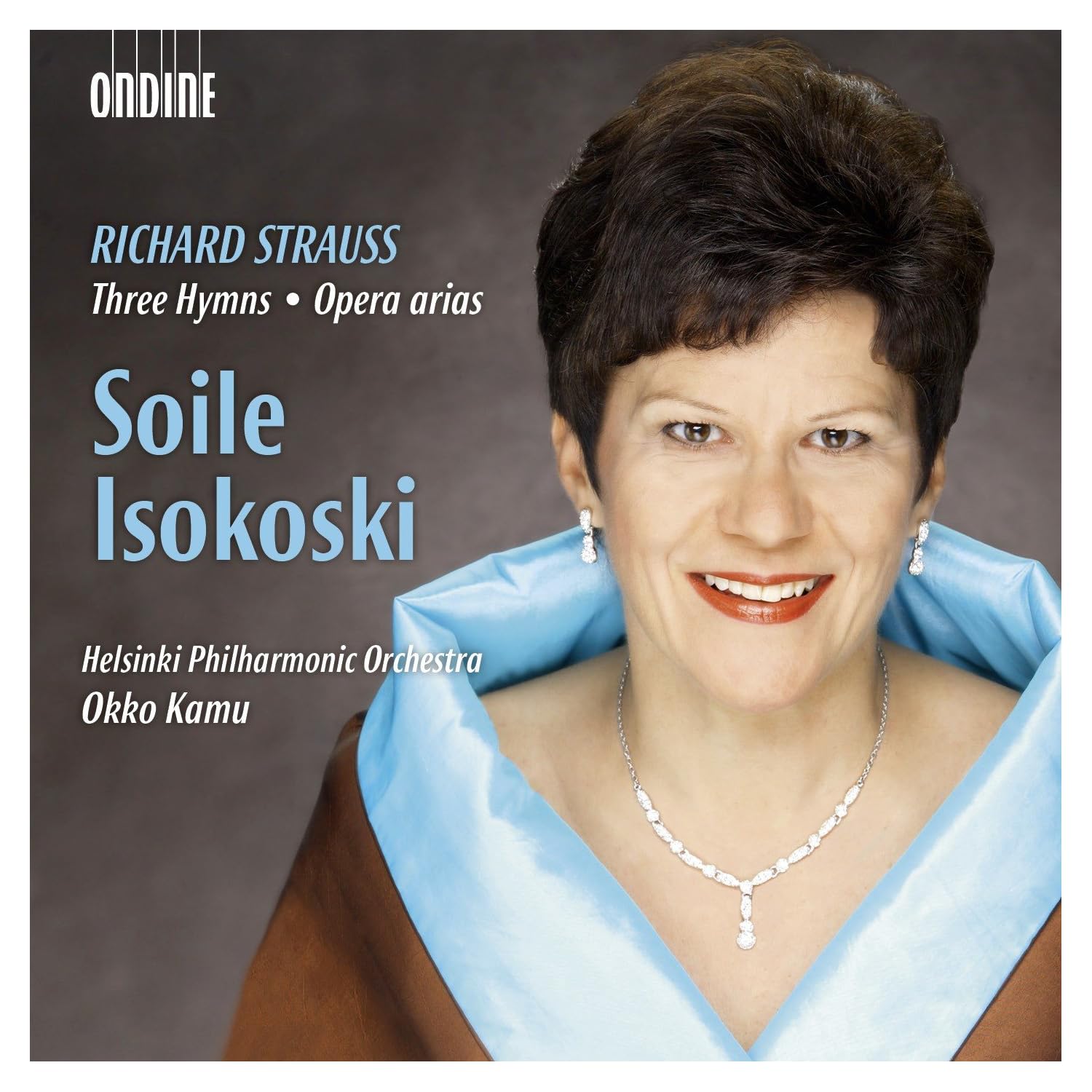
Soile Isokoski's decade old recording of the Four Last Songs was rightly heralded by the critics at the time as a major new release - a voice of shimmering beauty in pristine condition giving a radiantly pure reading of the autumnal (yet evergreen) song cycle, along with a wide selection of other orchestral songs, most still relatively rare in the concert hall, presented with the most advantageous advocacy from singer and orchestra.
So how does this follow up fare? The focus this time is far more on operatic repertoire and we have excerpts from Der Rosenkavalier, Ariadne and Capriccio, along with the rarely heard Three Holderlin Hymns. The ultra silvery brightness and delicacy to the sound is still there, and the formidable technique still fully in evidence, though the vibrato has subtly widened, and there isn't that last degree of ease and fluency that was so appealing in the last record. Still, there are few sopranos around who are singing like this at the moment, so one cant complain too much in this regard.
What I do have issues with is the lack of commitment to characterisation. The blankness of her portrayals, a kind of anti-expressionismo, where an "instrumental" sound is almost always preferred to meaningful response to the text, simply will not do in Strauss of all composers, whose marriage of word and music is probably the tightest of any composer. (Wagner marries text and sound very closely too of course and is Strauss' principal influence along with Schubert and Schumann, but Strauss outdoes them all for specificity of colour on each word in a phrase.) Occasionally Isokoski will shade the line such as the moment of self mockery when the Marschallin imagines herself as "Die alte frau ... Die alte furstin Resi". But then in "Die Zeit, die ist ein sonderbar' Ding", she might be singing about anything and it is a million miles from the whispered moment of realisation and quiet despair that Strauss has so movingly composed for the Marschallin. The extent to which she ignores not just the text, but the emotional tenor of this music is almost wilful and borders on the bizarre. Is she not moved by the beautiful music at least, if not by words? In the last Strauss recording she made, this bland, uncommitted quality came across as a sort of floating radiant purity, unusual in Strauss singing where the beauty of the music, and arching, aching phrases are often or even usually suggestive of rather more carnal activity. But it's not enough here.
That the language is not a priority for her is again reflected in her German which rarely sounds truly idiomatic, and occasionally is just plain bad - "Mashmal steh ich auf, mitten in die Nacht". "Der aufgeblasni schlichte Kerl". Very surprising especially considering how often she sings this role, but also the fact that this is a studio recording, where these things are so easily rectified.
Isokoski is singing Ariadne at Glyndebourne next summer. Glyndebourne being a small house makes it the perfect venue for her to sing this role, which is at least one vocal category too big for her really. As I noted before when I saw Fleming's debut in this role earlier this year, my preference is for a silvery, lyric sound in this part (see: Schwarzkopf, Della Casa), though that doesn't mean that the low tessitura can be ignored. Isokoski lacks the chest resonance that this role ideally calls upon (which conversely is surely part of the reason for her vocal longevity), but she does sing very beautifully in the high lying phrases, and she can get away with less characterisation as Ariadne is not the four dimensional character that the Marschallin is. Still there are textual problems ("Stilla Gott"), and vocal shading seems incidental rather than chosen to match the music and text.
The final scene of Capriccio, one of Strauss' finest inspirations, is again beautifully sung, Isokoski giving full thrift to the huge arcs of melody, never once sounding strained, and from a purely singing perspective she is most successful here of the operatic excerpts. But once again, the lack of attention to the text means it isn't as moving as it should be. I won't go on about it.
The orchestral songs fare better. It almost goes without saying that operatic characterisation is very different from interpreting a song. The former is about creating and developing a believable, fully rounded character, the latter about presenting a poem in heightened form and communicating its ideas. Naturally, the same technical and interpretive skills are used in each but with a subtly different order of priorities. Some singers can do both superlatively, some can do one and not the other, and some can do neither, despite having a wonderful voice!
The Three Holderlin Hymns of 1921 are not top drawer Strauss, though they do point the way towards the "late" Strauss (which wasn't to emerge fully for another 2 decades) in their ecstatic soprano soaring against a softly shifting, fundamentally rather plain, though magically glowing orchestral background. There are many wonderful moments to cherish (not least the beginning of the second hymn, Ruckkehr in die Heimat, and the closing minutes of Die Liebe), though by this stage in his life, Strauss' finest song writing was mainly behind him and they lack the freshness, spontaneity and originality of his earlier orchestral songs. After his relentless exploration of presenting the text in his contemporaneous opera Intermezzo, Strauss takes a break here word painting wise, and he just lets the soprano sing on and on. This suits Isokoski just fine, and she finally recalls the lovelyness of her previous Strauss recording, seeming much more in her element, not just interpretively, but technically too, the voice ideally matched to the surging orchestral canvass.
The playing of the Helsinki Philharmonic Orchestra is mostly fine, accurate and detailed, though occasionally there is a little slackness, and Okko Kamu's direction lacks forward momentum and drive. This is not a matter of speed - things are on the brisk side even, especially in the Ariadne excerpts, but somehow the internal tensions of the music have to drive the music forward, and there's rarely a feeling of that here outside of the songs.
-------------------------------------------------------------------------------------------------------
I don't want to seem like a one track reviewer, but this is my blog and so I will indulge myself. This CD made me return once more to Fleming's Strauss Heroines CD, and once again I simply marvel at the artistry. In it's prime in the late 1990s, Fleming had an even more beautiful instrument than Isokoski's, just gleaming and glowing with overtones, and a better technique that is even freer to sing every phrase exactly as the singer wants. But most importantly we get the sense that in German repertoire at least, she is an interpretive artist of the highest calibre and stature: her pointing of text and line is endlessly nuanced, her selection of vocal colours and timbres, emotions and mood always apt and can change on a knife edge, every word matters, yet almost miraculously she never gets in the way of the line, the legato absolutely exquisite and apparently endless. She knows when Strauss wants the voice to bloom and when to hold back, and these are portrayals of the utmost feeling and depth in every parameter. Bonney and Graham are ideal partners, and the Vienna Philharmonic with Eschenbach at the reigns make one of the most glorious sounds ever committed to disc.
Soile Isokoski
3 Hymns - Opera Arias Helsinki Philharmonic Orchestra, Okko Kamu
Soile Isokoski's decade old recording of the Four Last Songs was rightly heralded by the critics at the time as a major new release - a voice of shimmering beauty in pristine condition giving a radiantly pure reading of the autumnal (yet evergreen) song cycle, along with a wide selection of other orchestral songs, most still relatively rare in the concert hall, presented with the most advantageous advocacy from singer and orchestra.
So how does this follow up fare? The focus this time is far more on operatic repertoire and we have excerpts from Der Rosenkavalier, Ariadne and Capriccio, along with the rarely heard Three Holderlin Hymns. The ultra silvery brightness and delicacy to the sound is still there, and the formidable technique still fully in evidence, though the vibrato has subtly widened, and there isn't that last degree of ease and fluency that was so appealing in the last record. Still, there are few sopranos around who are singing like this at the moment, so one cant complain too much in this regard.
What I do have issues with is the lack of commitment to characterisation. The blankness of her portrayals, a kind of anti-expressionismo, where an "instrumental" sound is almost always preferred to meaningful response to the text, simply will not do in Strauss of all composers, whose marriage of word and music is probably the tightest of any composer. (Wagner marries text and sound very closely too of course and is Strauss' principal influence along with Schubert and Schumann, but Strauss outdoes them all for specificity of colour on each word in a phrase.) Occasionally Isokoski will shade the line such as the moment of self mockery when the Marschallin imagines herself as "Die alte frau ... Die alte furstin Resi". But then in "Die Zeit, die ist ein sonderbar' Ding", she might be singing about anything and it is a million miles from the whispered moment of realisation and quiet despair that Strauss has so movingly composed for the Marschallin. The extent to which she ignores not just the text, but the emotional tenor of this music is almost wilful and borders on the bizarre. Is she not moved by the beautiful music at least, if not by words? In the last Strauss recording she made, this bland, uncommitted quality came across as a sort of floating radiant purity, unusual in Strauss singing where the beauty of the music, and arching, aching phrases are often or even usually suggestive of rather more carnal activity. But it's not enough here.
That the language is not a priority for her is again reflected in her German which rarely sounds truly idiomatic, and occasionally is just plain bad - "Mashmal steh ich auf, mitten in die Nacht". "Der aufgeblasni schlichte Kerl". Very surprising especially considering how often she sings this role, but also the fact that this is a studio recording, where these things are so easily rectified.
Isokoski is singing Ariadne at Glyndebourne next summer. Glyndebourne being a small house makes it the perfect venue for her to sing this role, which is at least one vocal category too big for her really. As I noted before when I saw Fleming's debut in this role earlier this year, my preference is for a silvery, lyric sound in this part (see: Schwarzkopf, Della Casa), though that doesn't mean that the low tessitura can be ignored. Isokoski lacks the chest resonance that this role ideally calls upon (which conversely is surely part of the reason for her vocal longevity), but she does sing very beautifully in the high lying phrases, and she can get away with less characterisation as Ariadne is not the four dimensional character that the Marschallin is. Still there are textual problems ("Stilla Gott"), and vocal shading seems incidental rather than chosen to match the music and text.
The final scene of Capriccio, one of Strauss' finest inspirations, is again beautifully sung, Isokoski giving full thrift to the huge arcs of melody, never once sounding strained, and from a purely singing perspective she is most successful here of the operatic excerpts. But once again, the lack of attention to the text means it isn't as moving as it should be. I won't go on about it.
The orchestral songs fare better. It almost goes without saying that operatic characterisation is very different from interpreting a song. The former is about creating and developing a believable, fully rounded character, the latter about presenting a poem in heightened form and communicating its ideas. Naturally, the same technical and interpretive skills are used in each but with a subtly different order of priorities. Some singers can do both superlatively, some can do one and not the other, and some can do neither, despite having a wonderful voice!
The Three Holderlin Hymns of 1921 are not top drawer Strauss, though they do point the way towards the "late" Strauss (which wasn't to emerge fully for another 2 decades) in their ecstatic soprano soaring against a softly shifting, fundamentally rather plain, though magically glowing orchestral background. There are many wonderful moments to cherish (not least the beginning of the second hymn, Ruckkehr in die Heimat, and the closing minutes of Die Liebe), though by this stage in his life, Strauss' finest song writing was mainly behind him and they lack the freshness, spontaneity and originality of his earlier orchestral songs. After his relentless exploration of presenting the text in his contemporaneous opera Intermezzo, Strauss takes a break here word painting wise, and he just lets the soprano sing on and on. This suits Isokoski just fine, and she finally recalls the lovelyness of her previous Strauss recording, seeming much more in her element, not just interpretively, but technically too, the voice ideally matched to the surging orchestral canvass.
The playing of the Helsinki Philharmonic Orchestra is mostly fine, accurate and detailed, though occasionally there is a little slackness, and Okko Kamu's direction lacks forward momentum and drive. This is not a matter of speed - things are on the brisk side even, especially in the Ariadne excerpts, but somehow the internal tensions of the music have to drive the music forward, and there's rarely a feeling of that here outside of the songs.
-------------------------------------------------------------------------------------------------------
I don't want to seem like a one track reviewer, but this is my blog and so I will indulge myself. This CD made me return once more to Fleming's Strauss Heroines CD, and once again I simply marvel at the artistry. In it's prime in the late 1990s, Fleming had an even more beautiful instrument than Isokoski's, just gleaming and glowing with overtones, and a better technique that is even freer to sing every phrase exactly as the singer wants. But most importantly we get the sense that in German repertoire at least, she is an interpretive artist of the highest calibre and stature: her pointing of text and line is endlessly nuanced, her selection of vocal colours and timbres, emotions and mood always apt and can change on a knife edge, every word matters, yet almost miraculously she never gets in the way of the line, the legato absolutely exquisite and apparently endless. She knows when Strauss wants the voice to bloom and when to hold back, and these are portrayals of the utmost feeling and depth in every parameter. Bonney and Graham are ideal partners, and the Vienna Philharmonic with Eschenbach at the reigns make one of the most glorious sounds ever committed to disc.
Friday, 29 April 2011
Capriccio Met Opera Broadcast review
23/04/11
Metropolitan Opera House broadcast
There has been a very large hiatus since my last blog post, unintentional, but caused by my extreme busyness in the last few weeks. Reviews of Fidelio and the Tsar's Bride at the ROH hardly seem worth publishing in full, but I'll post a few thoughts in the future for the sake of completeness.
I had originally also planned to produce a series of posts on the complete operatic oeuvre of Strauss in preparation for this broadcast of Capriccio, and although most are almost finished, I didn't quite manage them on time - they'll be coming soon no doubt.
Capriccio is in my opinion Strauss most perfect opera, and as is suggested by my namesake, is held very dear to my heart. In some ways it's my favourite opera of all, and its gradual ascension into the fringes of the canon fills me with great joy. The fact that it has been presented in a Metropolitan Opera broadcast is further indication of its rising status.
Now I must confess that this was my first Met broadcast experience, and on the whole it was not a good one. Throughout the entire thing the sound was extremely muffled and quiet, which I blame the cinema for, and the transmission went awry several times during the glorious final scene, which I think is the fault of the Met. I'm seeing Die Walkure in mid May at the Barbican, so we'll see how that fares, but I'm now wary of the whole thing, where before I was wildly enthusiastic. For me it's clear that this is (or could be, or should be) the future of increasing opera's appeal and winning new audiences, rather than trying to make opera ticket prices less expensive, or mounting operas with self consciously tawdry "modern" themes.
I don't like this production by John Cox. The same set (by Mauro Pagano) has been presented in crinolines, notably with Kiri as countess, and with updated furniture and costumes several times - again with Te Kanawa at the Royal Opera house in the mid 90s, and here at the Met with the costumes again changed (this time the decor and costumes by Robert Perdziola). The whole thing is quite unimaginatively done, doing no more or less than what is in the libretto - characters just walk on and off, with little thought for how the thing will look on stage. In this opera, the Countess Madeleine has to be the focus of the production for the piece to make sense, and this means looking the part too - there has to be a reason that she arouses such excitement in the poet and composer. Unfortunately Fleming's dress, makeup and hair all conspired to look extremely unflattering and partly because of this, and partly because of the poor direction, she hardly seemed to register as the central figure of the action until the last scene, where it was all too late. This was an instance where one realises how important costumes (combined of course as good direction) actually are in opera. Compare this with Carsen's production where everything is just right in this regard - Fleming looking extremely beautiful here and being the firm focus of the action (the direction, while superficially similar, is also much better. The only thing that mars the Carsen production, and it's a big fault, is the horrible treatment of the final scene.)
Other things that grated were the pointless cuts - pointless because they hardly shortened the the thing, and annoying because what was cut was so crucial - first the discussion about the theme of the opera that they are going to write - The Count's felicitous suggestion comes far too soon, and hardly registers as the theatrical masterstroke that it is. Little cuts in La Roche's speech (it's meant to drag!), and the discussion of the opera after the counts suggestion again cut out further beauties, whilst hardly shortening it - Strauss' dramatic pacing is perfect here, and meddling with it because you don't know how to direct it is death. It also irked me that they changed the libretto (something which I've never heard of before) to fit with the updating as the Count leaves with Clairon - they're meant to talk about horses, and she said she is awaiting at least six (a possible sexual pun here), but instead a coupe and a limousine are mentioned. This last point is minor in some ways, but I'm sure will have annoyed many devotees of this work.
Renée Fleming is the world's reigning Strauss soprano. Twelve years ago she recorded what is to me the most gloriously beautiful and intelligently sung recital of Strauss excerpts on disc. The Marschallin's monologue on that CD is not only radiantly beautiful but has an intelligence and sensitivity to the text matched only by Schwarzkopf. The luxuriantly schmaltzy duet for the sisters in Arabella is sumptuous, and then the last excerpt, the final monologue scene from Capriccio is the most ravishing of all, the finest account of this scene on record, both in the breathtaking singing, and the peerless beauty of the Vienna Philharmonic under Eschenbach.
It's fair to say then that I am a Fleming fan. In fact she is unequivocally my favourite singer. How has the voice fared since that CD then? Fleming is now 52, and while the voice still is remarkable for her age, there are unmistakable signs of decline in the voice. This completely to be expected for a soprano of her age, and there are without question several years of very healthy singing ahead of her (plus two new Strauss roles - Christine from intermezzo, and the long promised Ariadne. More on these later) I won't go too much into this, as I want to do an overview of her career in a separate post. Her acting on this occasion didn't really do it for me, strange since it's so much better in her Carsen DVD performance. Bad direction? It was just too OTT and camp. That was a theme of the whole thing actually - for Capriccio to succeed, it cannot be a camp indulgence, but that is exactly how the Met presented it and as a result the whole thing was curiously uninvolving.
Joseph Kaiser's Flamand was a bit rough around the edges for my liking, and completely overacted (this is a subtle piece. Subtle!), though he delivered some quite considerable goods in his ardent monologue in praise of the Countess. Olivier, played by Russell Braun, was rarely anything but brooding and discontented, and again whether this was poor direction, or poor acting choices, is hard to say. This is always a risk in Capriccio, because although the Countess doesn't officially come to a decision at the end, Strauss hints at her choice of the composer in several ways (more on this in another post). If these hints aren't subtle, and she clearly is far more interested in the composer than the poet, as here, the central metaphor doesn't hold up, the little drama that there is falls flat, and the final scene makes no sense. Another major problem.
Morten Frank Larsen was a decent count, but largely unremarkable. La Roche was well played and sung by Peter Rose, and oddly became the centre of the action. Very good though he was, what was strange was that Olivier, a baritone, had a darker tone quality to his voice than La Roche, a bass, which really didn't work in terms of the roles they were meant to be playing, and the operatic conventions that Strauss is so clearly playing with. Real miscasting this. Sarah Connolly as the actress Clairon was again decent, but the comedy somehow failed to catch light - and Connolly really is a good actress, so one strongly suspects that this was the poor direction again.
The vignettes were mostly nicely done, even if the whole didn't flow like it was meant to. The scene with the ballet dancer was beautiful, and then the Italian singers duet was lovely, but seemed irrelevant, because the other characters were hardly seen reacting to them. The farewells were again badly handled in the direction (the countess here again clearly favouring Flamand). The scene with the servants, another joy of this opera, was brilliantly executed in its semi-choreography and humour. Unfortunately, the even more delightful following scene with the prompter was marred by the Bernard Fitch's complete lack of voice - the Met should maybe note that the fach "character tenor" still has the word tenor in it.
The orchestra under Andrew Davis was on absolutely magnificent form - I really have never heard this score played better - beautifully shaded, the details coming out wonderfully, and such warmth too. Occasionally a few of the orchestral "jokes" were smoothed over, but this is caviling. There was one excruciating horn flub in the exquisite horn melody that introduces the final scene - I wonder if they'll correct this if this performance ends up on DVD?
So an unsatisfying performance. What really emerged triumphant against the dull staging and poor acting, was the magnificence of the music: it's wit, intelligence and perfect, muted beauty. I couldn't help but fall in love with the piece again.
Subscribe to:
Posts (Atom)