Musings and updates at twitter.com/capriccioblog
Showing posts with label Renée Fleming. Show all posts

Monday, 26 August 2013

DVD Review: Der Rosenkavalier 2009 Baden Baden with Fleming, Koch, Damrau, Kaufmann and Thielemann

Decca

Feldmarschallin: Renée Fleming
Octavian: Sophie Koch
Sophie: Diana Damrau
Baron Ochs: Franz Hawlata
Faninal: Franz Grundheber
Italian Singer: Jonas Kaufmann
Annina: Jane Herschel
Valzacchi: Wolfgang Ablinger-Sperrhacke
Marianne Leitmetzinen: Irmgard Vilsmaier

Conductor: Christian Thielemann
Direction, set, costumes: Herbert Wernicke


Herbert Wernicke's production of Der Rosenkavalier is updated but not to a specific historical time, which saves it from the pedantry and overload of so many "traditional" Rosenkavalier productions. It is however also relatively uninterventionist in terms of presenting the opera, so there's no Regie theatre excesses to worry about either - the adjective "timeless" for once seems a reasonable word to use. The revival direction is surprisingly good, with lots of lovely details of characterisation, and most of the principals seem totally physically and vocally at ease with their roles, giving them a real freedom and immediacy on stage. Christoph von Bernuth is listed as director's assistant but considering that Wernicke had long been dead when this was filmed can we assume that this is a synonym for revival director?

The set is comprised of enormous mirrors which reflect different backgrounds (mostly of ultra opulent 18th century interiors) and can be quickly rotated to produce different atmospheres and settings. A smaller mirrored screen demarcates a more intimate area for the opening bedroom scene (and subsequently also the seamier bedroom in Act III); the floor is also a mirror. Costumes and hairstyles do not anchor anything down and come from a mix of eras - the lackeys look 18th century, the rest 20th century. It doesn't feel like a mishmash because these questions of style are never the point of the production. I have expressed my reservations before about totally "traditional" 18th century Rosenkavaliers - I simply don't think that the glutinous beauty and frenetic nervosity of Strauss' score reflects that era at all, and the excuse for clutter, fussiness and ahistorical kitsch that Der Rosenkavalier seems to bring out of directors of a certain bent is happily sidestepped if it's updated in some way. (I think Strauss' own time of composition works wonderfully with the music and makes sense dramatically too - the fading upper classes, rising middle classes, the feeling that old Vienna was on the way out, the coming of the Great War - we are dealing with a Feldmarschal remember, and it's oft forgotten that Faninal has made his millions as an arms dealer...) Non-historical settings can sometimes be bland and characterless, but somehow this production does manage to conjure a sort of fictional society that is reasonably believable, if not quite as meticulously detailed as what Hoffmannsthal and Strauss intended. We can however imagine these characters out of their immediate context, which for me is a decent measure of how believable the story telling is.

The Act II duet is a coup de theatre and time stands still: Octavian arrives on a huge flight of stairs, the couple in a curious suspension above the main stage, only descending down the steps and back to earth at the end. The servants have disappeared, making it a more intimate scene than is normally the case. The lederhosen donning Ochs turns out to be not just unbearably impolite, but in fact totally outrageous to Sophie, and her anger is very real and wholly justified, much as she tries to make the best of it at first. When he sings his waltz song she is sobbing on the floor, and he leers over her, clearly enjoying his power. Grim. The Act III farce is only intermittently funny, acceptably choreographed to the music, but relies a little too much on Hawlata's improvisational ingenuity - if he didn't know the role so well I think it would be very dry indeed and many actions are expanded far too much in time. I've never seen the masquerade totally convincingly staged I have to say, and like in most productions, things focus again at the re-entrance of the Marschallin.

This Marschallin has an iron fist inside the velvet glove and her dismissal of Ochs is extremely firm (and therefore satisfying). The final trio and its preceding scene are beautifully handled. Sophie's costume subtly mirrors the Marschallin's, underlining the hinted at similarity between the two women from the first act, which is of course the reason for the Marschallin's vexation with Ochs. The young couple's blissful love is for once as believable and stirring as the Marschallin's sighing resignation, making the conflict and eventual resolution bittersweet yet tolerable, when so often there's the suspicion that the new relationship is flimsy and only skin deep. At the final curtain Mohammed, here a Pierrot (presumably for reasons of political correctness), appears and replaces the silver rose with a real one - a symbol of nature and true love triumphing over formalised, arranged, economically prudent courtship.

I've noted before on this blog that Renée Fleming is not at her best as an actress in light comedy mode, so despite some nice moments from her in the opening scene, she comes across as a bit artificial (though nothing like as bad as in the Met production, see below). But at "Mein lieber Hippolyte" and then from "Da geht er hin" to the end of the first act she suddenly focuses vocally and acting wise to give one of the best performances of her career. For that glorious half hour scene and indeed the rest of the opera she fully becomes the Marschallin and in this exceptionally pained portrayal she takes the role further than any of her colleagues on DVD. Catching every subtle play of emotion in the score, she channels it through the myriad colours of her voice, and her superb attention to the text combined with her perfect legato gives full thrift to Strauss' inspired vocal writing. Physically too the embodiment becomes completely natural, and her interactions with Octavian are heartrending as he struggles to understand why she is pushing him away. What is so impressive is how specific and improvisatory everything feels: there is no question that this is coming from a place of very genuine emotion.


[As an aside: anyone who saw the Met Rosenkavalier HD Broadcast that Fleming did in early 2010 will be very surprised with this DVD. In fact, I'm staggered at the difference in quality between that broadcast and the present DVD. Filmed in 2009 (in my opinion the last year of her vocal prime) her voice is in much better shape in Baden Baden: a better supported line, unexaggerated, and simply more beautiful, (listen for instance to her unbelievable opening phrase in the trio) but what differs most markedly is her physical and emotional portrayal of the Marschallin. Whereas in the Met production she is completely self indulgent, mugging and swanning about, and as a result is not very likeable, in Baden Baden she gives one of the most compelling performances of the Marschallin that I have ever seen. The only explanation I can proffer is the different direction that she's responding to. It doesn't help of course that the Met one is filmed like a soap opera and is in the Met's mega kitsch, tackily costumed and now dated looking production (demonstrating so much of what is wrong artistically with the Met).]

Initially I didn't at all like Sophie Koch as Octavian, finding her vibrato too wide, her acting overdone, and her ultra mobile mouth too distracting with all the closeups. But having seen this DVD several times now, I think she makes an excellent casting choice in being so contrasted with Fleming's precision and vocal beauty - in the latter half of Act I, the difference between Octavian's youthful ardour and unsophisticated bluff and the Marschallin's philosophical wistfulness has never seemed so irreconcilable or poignant. This alone is worth the price of admission and makes it one of the moving versions on DVD.

Diana Damrau's Sophie is not an unqualified success - there are some good things vocally, but the phrasing frequently bulges unmusically (explosions of vibrato after straight tones), and she doesn't have that crystalline purity of tone that one associates with the greatest Sophies. However, I like her minxy acting and that in this production she's not an air headed ditz - we know that she's a proud, slightly spoiled brat, but she's clever and sympathetic too, and her joy in the final scene is palpable. Her final conversation with the Marschallin is another lovely piece of characterisation.

Franz Hawlata's Ochs is brilliantly horrible: his half closed, inward looking, plaice-like eyes and unflagging sense of entitlement perfectly produce a portrait of insuperable egocentricity and supreme self satisfaction. He is in no way a manipulator or intriguer: he genuinely believes in his own superiority and irresistibility, the real world merely bouncing off his unassailable self belief. Vocally Hawlata is far from opulent, but his experience with the part makes this demanding and not particularly grateful role seem like a walk in the park.

Franz Grundheber is vocally far past his best, but he makes more of Faninal than we often see. Jonas Kaufmann is a very unitalian Italian tenor, but oh my what a delicious cameo - certainly the best sung I've heard this infamously difficult aria.

Christian Thielemann conducts the Munchner Philharmoniker and the sound is glorious - full and rich, the orchestral picture always detailed, with superb phrasing and large contrasts of weight and character. It's not quite as subtle or ravishing as Eschenbach is with the Wiener Philharmoniker on the wonderful Fleming Strauss Heroines disc, but Thielemann is sprightly and driven, and supports the singers just as well.

A very worthwhile DVD, absolutely essential for anyone who loves this repertoire.


Wednesday, 24 July 2013

Capriccio in Concert, take II

21/07/13

This was the second and final performance of this duet of concert Capriccios at the ROH. To read a fuller review of the first night, click here.

Renée Fleming gave a more controlled performance this second night, with far less scooping, and there were no moments of dodgy sound production (there were a couple of small cracks on the first night). It was overall a slightly smaller scale performance, but in the final scene she was even more captivating than on the first night, getting rid of quite a lot of the forced theatrics, presenting it this time as a single dramatic and emotional arc, pain and beauty merging with obvious personal significance. Great to witness.

Gerhaher ironed out the little problems with text and lack of familiarity that he had had on the first night, again delivering a superb performance. His Olivier is moody, and even angry at times, and I have to say that this interpretation is one followed by directors quite a lot, with Flamand being the easy going, more romantic suitor. So many productions of Capriccio seem to have the Countess slightly (or more than slightly) favouring Flamand, and there is endless discussion in articles about the opera about whether that gorgeous final scene contains clues as to Strauss' preference (e.g. the banality of the final words compared to the sublimity of the music). The articles miss the point of the ambiguous ending I think, and directors who fail to make Olivier as attractive as Flamand as a character weaken the ending. The message of the piece is for me somewhat distorted if one is clearly more appealing to Madeleine than the other.

Unfortunately Andrew Staples was sounding a little hoarse on the second night, though he still sang well despite this. Peter Rose didn't seem to tire at all as La Roche, giving an even more impressive account of his monologue than the previous evening, and Bo Skovhus too seemed musically more in his stride as the Count. Everyone else sang well. The orchestra were a little more on top of the score this evening, but some of the magical sparkle of the first night was missing. Still, had I not heard Davis with the ROH Orchestra on the first night, I would have been very pleased with this performance.

I mentioned a significant cut in my first night review, but were there other small cuts? I don't remember hearing mention of who gets to be the tenor in the piece (though La Roche still gets his line about being the basso buffo), but I'm always reticent to say for sure on these things, because I may just have missed it because my attention was on the orchestra or something.

Saturday, 20 July 2013

Capriccio at the Royal Opera House with Renée Fleming

19/07/13

What a gift. I was beginning to wonder whether Strauss' final and most perfect opera Capriccio simply was too rarely put on and too demanding in live performance for it to be likely that I'd ever see a really good one, but this was great. I was astonished to discover that the ROH has staged the opera fully only once - that was in 1991 with Kiri Te Kanawa. (In 1953 the Bavarian state opera came with a visiting production). This evening was a "concert performance" but it verged heavily towards "semi-staged" - Fleming and Skovhus, both of whom have done the opera many times, sang without music, and there was plenty of moving around and interaction from everyone. In fact it was an object lesson in how little has to happen for an opera to feel like it is being dramatically (rather than just musically) realised. It's probably my favourite opera so it's hard to be objective about how effective the set up was, but its cherished status for me means that it's also easy to be critical and I must say I was riveted and entertained throughout, which is more than I can say for some productions I've seen of the piece. How revealing to have Strauss' music for stage and scenery, with much of the action in the minds eye. Strauss gives us it all in his wondrous score which (as with all his operas) is so rich and detailed that it actually can become a challenge to stage.

The ROH used their "Royal Festival Hall" concert shell, with the orchestra on stage, the singers in front, and conductor Andrew Davis amongst the singers, a considerable distance from the orchestral musicians (many of whom weren't facing him as a result.) The concert shell does wonders for the ROH acoustic, at least for the front stalls where the sound can be poorly balanced and muffled. The ROH orchestra with Davis made for an interesting comparison with the Wiener Staatsoper orchestra (ostensibly the Vienna Philharmonic) and Christoph Eschenbach who I saw doing the piece last month (also with Fleming - see my review here). Individually, the playing of the ROH orchestra was sometimes questionable - the opening string sextet had some ropey moments (the offstage sextet sounded magnificent though!) and the gorgeous horn solo that introduces the famous final scene was hesitant and contained at least one crack - but overall this was by far the more convincing performance. The orchestral sonorities were more beautifully and warmly achieved, the underlying flow and momentum that links the fragmentary orchestral writing more convincing here, and the chiaroscuro contrasts of texture were more ably handled by Davis and his orchestra. Davis has a superb measure of the score, and conducts it with obvious love and affection - there were things in the orchestration that I'd never noticed before, and the vocal octets were more brilliantly performed than I have ever heard them before. The pacing always felt right and throughout the words were fully understandable from all - all in all then a superb ensemble achievement, niggles aside.

Renée Fleming did some wonderful things as the Countess Madeleine, proving she still has the goods when it counts. In Vienna last month she sang much better than she did here however - the line was firmer and purer, the text not so exaggerated. It is a common criticism of Fleming that she overinflects the text, and uses expressive portamentos to excess. As a Fleming fan (to put it mildly), these things have never bothered me in the past because the legato is so utterly flawless and in such perfect equipoise with the diction, the basic sound extremely firm and well supported, the phrasing pliant and sensitive, and the text so beautifully coloured by the voice. It's a voice I know supremely well, and here, I sadly felt that she was overcompensating for a slight loss of control that must be disconcerting for her - the scoops were often very extreme, even becoming yelps at times, especially in the more conversational moments where the line is harder to maintain, and sometimes the word stresses became so emphatic that the line was distorted. But then she'd whip out the trademark legato for one of the extended arioso moments and we'd hear the Fleming that we know and love from her recordings. In the final scene, she came on "dressed for dinner" in her Vivienne Westwood sequinned gown, now with a massive gold and silver overcoat, and we got her best singing of the evening - the huge dramatic outpourings which follow the recapitulated sonnet soared with powerful abandon, and the floating pianissimos of her final few phrases were magically dispatched. Fleming can be a very moving actress, but left to her own devices without a director her acting here felt unfocussed and even hammy - lots of pouting, posing questioningly with the sonnet, arm shaking, and the like. Again, she was at her most moving when she opted to do less, simply letting the music flow through her and naturally illuminate her expressions.

Christian Gerhaher was an almost perfect Olivier - I simply cannot think of a currently active singer who could be more ideal for this role. His precision and extraordinary way with the text is totally fitting for the character, but the beautifully balanced timbre and wonderful legato mean that Strauss' music is also fully served. It's a much bigger voice than I remember hearing when he did Wolfram in Tannhauser here back in 2010. Bizarrely and almost amusingly he totally muddled up the words for the sonnet when he was addressing Fleming in plain speech, but even before he went wrong, I thought his delivery of this spoken text wasn't quite heartfelt enough - the only weak part of an otherwise superb vocal assumption of the role. His head was mostly quite buried in the score, so I wonder if this was his first performance of the part?

Andrew Staples, standing in for an indisposed Joseph Kaiser, made an excellent Flamand. His pointing of the text was not quite as nuanced or touching as Gerhaher's but his vocal contribution never felt out of place next to his stellar colleagues, and his beautiful scene in praise of Madeleine was sung with Mozartian clarity and refinement but with Straussian surge when the music asked for it. The timbre is not the most distinctive, or at least not yet, but it is nevertheless very pleasing. A very fine showing for a very fine young singer. Peter Rose was an equally excellent La Roche. It's not the biggest or juiciest bass voice, but his German is excellent, he "gets" the role fully, is funny without buffoonery, and his legato is very good. He seemed to tire a bit towards the end of his climactic speech, but this was another very pleasing performance.

Christine Rice was in such beautiful voice in her recent Minotaur appearances that I was quite sad about her having to cancel these performances of Clairon due to a quite serious illness. I hope she gets better very soon. Her replacement Tanja Ariane Baumgartner made more of this role musically than one might have expected in what is traditionally seen as an actress's role (Strauss makes sure she could never musically upstage his heroine, just as he had with Zdenka/Arabella a decade before). She has a dark coloured mezzo voice that contrasted very nicely with Fleming's silvery soprano, and meant they were never "in competition" as sometimes can seem the case. Bo Skovhus sounded better here than he had in Vienna, less gruff and with a fuller tone, and though arguably the role doesn't require, or even shouldn't be cast with a beautiful voice, the voice is sounding quite hardened and monochrome at this stage, and Skovhus was never the most finessed singer. That said, this wasn't a bad performance, certainly not a disservice to the role. Barry Banks and Mary Plazas made a good pair of Italian singers, Banks being particularly impressive. The female singer is almost always cast with a very light voice, as here, and I never quite know why, because the first entry sits very low for a long time, and the coloratura requirements are hardly demanding.

There's a small but painful cut which the ROH, Vienna and the Met all practise, coming just before the Count suggests his brilliant solution to the other characters' quandary as to what subject to make into an opera. It always jars, because the Counts suggestion simply comes out of the air, and not from the discussion, and so seems out of character for such a professed opera sceptic. Am I the only one that misses this part? Probably.

All in all, a very satisfying evening and a wonderful close to the ROH season. I will (obviously) be at the next performance as well, so will report back on that if I have more to say.


Sunday, 23 June 2013

Capriccio at Wiener Staatsoper with Renée Fleming

20/06/13
Vienna State Opera


[NOTE: if you're looking for the 2013 ROH Capriccio with Fleming, look here.]

Strauss' final opera Capriccio, the piece for which my blog is named, almost means too much for me to give an overview of why I value it so highly. The temptation would be to list every detail, every felicity, so when I have more time I will write up my thoughts into a coherent structure - since there are a couple of ROH performances coming up, that will provide a good deadline. For the time being, suffice it to say that this piece represents an exquisite final flowering of Strauss' operatic career, an unexpected return to the brilliance of the Salome - Elektra - Rosenkavalier - Ariadne period after approximately two decades of relative mediocrity (the best bits of Arabella and Daphne being the principle highlights that soar beyond the meticulous humdrum of most of his work from the 1920s and 30s). It ushers Strauss' late harvest of works of which the Four Last Songs are the most famous and celebrated and is every bit as recherché and exquisitely crafted as the songs.


This was a frustrating show because it was almost so good in every way. First, let's consider the design. From the photos above you'd be forgiven for thinking that this was one of the most visually alluring productions you're ever likely to see, and it certainly has its moments. Visually this show is best when the lighting is very focussed on the singers bringing them into heightened, luminous focus (as in the photos above, and a few others here), and I love the idea of a Capriccio in slightly surreal, glimmering half lights, as its so different from what I hold in my minds eye when I listen to the work. However this only happens occasionally, and all too often the singers and set are covered in a haze of blues, lilacs, oranges, yellows and pinks, and there are just too many colours and textures for the aesthetic to properly congeal, let alone be stylish. The last scene for instance, contrary to the neon beauty of the photo above, has much of its stark luminescence vitiated by very diffuse gels on the lights that nullify the intense colour, and do no favours to the set. We'll see how it looks on camera* as shows can look very different on the little/big screen to how they look in the theatre.

this sort of thing is closer to the production's norm.

these three as well. Lots of lovely things individually,
but a mishmash overall, and often not well lit.


Second, the direction. The main set components of Marco Arturo Marelli's production (he designed, directed and lit it) are a series of large triangular columns that each have three different faces representing three different levels of reality in the show. The visual effect is sometimes similar to Herbert Wernicke's Der Rosenkavalier. The stage opens on 1940's attired Flamand and Olivier (composer and poet) at their respective writing desks either side of the stage behind a gauze which blends smoothly from a chaos of notes to a chaos of words. Throughout the show this layer occasionally pops up but is not much developed. The principle action appears in a very stylised late 18th century setting and is presumably the opera that these two artists are constructing. But by teasing apart these layers that are implicit in the piece without providing obvious insights that this rending apart has opened us up to, it spoils something of this work's enigmatic unity, that special smiling glow and wistful humour that informs every bar of the score and text. Capriccio exists as a conversation piece on the nature of opera, a charming "period" romance set in an aristocratic salon, and simultaneously serves as its own explanation and deconstruction. The characters are both metaphors for the debate being enacted, archtypes, and detailed, living, believable people, whose complex desires and relationships drive the plot. It's all so artfully and effortlessly achieved that no further clarification is required: the piece itself is literally and metaphorically its own best explanation and it does it with a simple smiling elegance that it would be virtually impossible to improve upon. Marco Arturo Marelli writes with obvious love and understanding in his programme note, but he hasn't been brave enough with his vision.

This revival was very obviously very under-rehearsed. Although many of the singers from the début 2008 cast remain, they can't be expected to remember every detail in an opera as conversationally fleet footed and detailed as this without extensively re-engaging with the text, motivations and actions of the characters in this production again. It wasn't entirely clear from the booklet whether Marelli was back for this revival, but either way verbal queues were constantly missed and actions were often vague and indecisive. When Madeleine says "Fasst mich nicht an!", Olivier hadn't yet touched her, but then he awkwardly remembered he should have, and quickly grabbed her and then immediately lets go. Madeleine is meant to demonstrate the Rameau excerpt at the keyboard, but Fleming didn't get there in time, and just joined in with the offstage harpsichord way after the music has started. These are small things, but over an evening amount to a larger feeling of malaise that the singers are merely "walking through" the parts - often it seems unclear what characters actually mean by their words because their actions are ambiguous and approximate. The wonderful scenes where Olivier and Flamand declare their love were not convincing for this reason, and references to offstage action were also strangely glossed over or ignored in the acting. It's really not all bad though, characters do what they're meant to, it's not static, and there are nice touches also - the house lights going up a little when the characters all start talking about how strange opera is, adressing the audience all the while, and Olivier's cry of "Gondola, gondola!" when discussing Italian singing in the first scene, is picked up on later when the Italian Singers' duet is presented with them being carried about in gondolas. Olivier and Flamand, two sides of the same coin, wear mirror image costumes.


As I've said before, Renée Fleming is in my opinion the greatest soprano of the age, and when the prime was so effortlessly, ravishingly flawless, the autumn of the career comes all the more painfully. However, having seen her perform (a ridiculous) eight times last year, I can confidently say that this was by some distance the best I have seen her since I started blogging, a gratefully heard return to form. Although the timbre doesn't have the same glistening radiance that it used to, here the legato and exceptional support of the line recalled the glory days of "The Beautiful Voice", and in the all important final scene, the voice soared just as one might have hoped. Amazingly, from my seat Fleming's voice sounded larger than most of her colleagues (equalled only by Kurt Rydl), giving far more tone than I have heard her give for a long time. The textual acuity is remarkable as ever. Madeleine's tessitura sits higher than the Marschallin, but lower than Arabella, and may be her best role at this stage. Despite occasional lapses in specificity in her acting, she was the only singer to overall give a rounded and dynamic acting performance in her role perhaps because she has sung her role more often than her peers (?) but her elegance and humour and occasionally bratty playfulness all made for an engaging assumption of the part.

The rest of the cast were servicable, but noticeably not of world class standard, and for Capriccio to succeed it manifestly can not just be a star vehicle. Diction wise, I could only consistently understand Fleming, ironic since she is the only non native speaker apart from Skovhus, but it seems that the old singer's cliché that native speakers are usually more lazy with diction when singing in their own language is true. The role of Clairon is vocally a breeze for Angelika Kirchschlager but above all this is an actress's part and she made a curiously frumpy and charmless personality on stage. Part of it was her unflattering costuming, but she kept doing this thing where she'd reveal her trousered legs under her dress and it wasn't obvious whether this was meant to be a dramatic flourish or a sign of nervousness. This production makes her haughty and derisive, but there's got to be the inbuilt charisma to get away with the ill humour. Michael Schade and and Markus Eiche were vocally acceptable as Flamand and Olivier respectively, though were both a bit too much boyish swagger without offering the characters' sensitive vulnerability and charm. Bo Skovhus is hardly the most opulent voice, but was quite likeable as the playful count. Kurt Rydl's rather quizzical, sad La Roche laments the death of Bel Canto, sadly quite ironically here since the voice lacks anything resembling line these days, every phrase broken into individual words.

In the pit, Christoph Eschenbach astonishingly makes his Vienna State Opera début. It was not quite the perfect Capriccio I was expecting based on previous experiences of his conducting of the final scene, which must be ranked as the most gloriously beautiful and understanding of our time (thankfully enshrined on CD with the Vienna philharmonic on Fleming's Strauss Heroines disc.) The singers were never covered, and were followed and supported with great accuracy, and the orchestra was dazzlingly precise in its fragments of melody, but the sense of the longer line wasn't achieved until quite a while in. Since I was near the front, perhaps the sound wasn't ideal - I'd be fascinated to hear how it sounded higher up in the house where the sound it better. The final scene was as wonderful as ever though.


Overall I enjoyed this, and found it worthwhile despite its flaws.
*This production is being filmed for DVD (EDIT: though there were doubts about whether this was going to be released, it is, very soon!) which means, extraordinarily enough, that we will have three Fleming Capriccios on DVD. The Carsen 2004 production with Fleming in her peak voice is still the one to have as overall as it is the best directed, has the best supporting cast, and is the most visually beautiful. The Met DVD of the abominably drab Cox production which is the one wheeled out in most English speaking nations (in 20s/30s or "period" dress) finds Fleming at her most affected dramatically, a none too exciting cast, and of course the Met's horrible video direction (review here). The Marelli production is decent, but Oh how I wish we could have had the 2008 première when the cast were all newly rehearsed, and Fleming was in her prime. However, we can't have everything, and must be thankful that we are having it at all. Hopefully, over the next two evenings, the cast will hit their marks more often and they'll be able to patch together a convincing realisation of the staging. Also perhaps close-ups will help make the thing feel less "bitty". It will broadcast live on the internet on 27th June 2013.


Curtain calls:


this is the leg thing she kept doing

looked throughout like John Malkovitch in Dangerous Liaisons

The 1940's dress


Production photos (c) Wiener Staatsoper / Michael Pöhn

Friday, 8 February 2013

DVD Review: La Traviata 2009 Renée Fleming Royal Opera House

Opus Arte

Violetta: Renée Fleming
Alfredo: Jospeh Calleja
Germont: Thomas Hampson

Conductor: Antoni Pappano
Royal Opera House Orchestra and Chorus
Director: Richard Eyre


As with most Traviatas, this DVD is all about the soprano, and this version was surely filmed almost entirely for Fleming's sake. Fleming's singing of the Italian repertoire has been the most controversial aspect of her very broad ranging career, some complaining that her singing in this repertoire is fussy, mannered and stylistically wrong, but this is a very personal and individual performance from her that offers a great deal and was ecstatically reviewed at the time.

Richard Eyre's production is quite traditional and very adaptable to the strengths of the soprano which is probably why it has lasted so long at the ROH. He returned especially for this revival as he is a fan of Fleming, and as a result the direction is extremely detailed and there are countless moments of subtle but brilliant insight. Act I is the plainest and the set feels a bit cramped for a party and it isn't nearly seemy enough, but Eyre effectively and convincingly traverses the insane pace of Verdi's exposition. Fleming brings an unusual elegance, glamour and nobility to the role that is quite magnetic. I was actually surprised at how well Fleming acts in this Act - usually she is merely adequate when being happy on stage - she's generally much, much better at acting the bittersweet, the wistful, the sad, and even the angry parts of an opera, which is lucky, because that's basically what full lyric sopranos do for a living. Still the acting becomes quite artificial here especially when she's thinking about singing the right notes during "Sempre Libera" which taxes her enormously, noticeably more so than it had done in her previous outings of this role. In an interview she has said: "I don't think anyone enjoys singing this... I don't know a single soprano who likes it... it's not written well for the voice." She certainly gets through it just fine, but it's not quite as effortless as we're used to from her (but then we must remember how astonishing that she is singing this well at 50). Calleja is at his weakest here too and seems not at all engaged dramatically. Luckily they both warm up in the following acts.

Act II is also conventionally staged, but again there are lots of lovely details of characterisation and points of telling interaction between the characters. Violetta's anger and panicked outburst in Act II seems to surprise her even more than it does Germont: she isn't aware of the strength of her own feelings until this moment, and this threat to her relationship unexpectedly and explosively forces her to face up to her own mortality - the crisis we realise has been bubbling beneath the surface for some time. It's very powerfully presented. Fleming's "Dite alla giovine" is truly exceptional, and now that she's in her home ground dramatically, the emotion feels completely genuine for the first time. Interestingly Fleming's Violetta is very forthright and far more upstanding than we usually see - Fleming's view is that Violetta is popular because she has such strong moral integrity and this certainly shows in her portrayal. Traditional productions such as this do tend to ignore the sleazy aspects of the story, going with the "courtesans were immensely cultured women" line, which suits Fleming's character and attitude, but it's clear that its only part of the story, and a sentimental dishonesty too.

Despite some questionable acting, Thomas Hampson manages to be an extremely unpleasant Germont - he's not just misguided and oblivious to the seriousness of his actions as he is often portrayed - here he merely plays dumb, and is otherwise manipulative, callous, cold, violent, entirely self serving and without remorse. Vocally Hampson is very accomplished, though by his own high standards seems not entirely comfortable as it's not really his fach, but he is of course a very talented singer and is more than capable of singing the part.

Fleming's Act III is perhaps not surprisingly her strongest, and it's simply heartbreaking. I can't think of any other currently performing soprano who could deliver this much pathos vocally in this scene. The beauty of the voice, so sensitively coloured and frail, is quite miraculous. Violetta's passionate outbursts are huge releases of energy which we see she must recover from, every show of strength has its immediate cost - all this Fleming manages to put into the music without endangering the line. I would say that 2009 is the last year of Fleming's prime - the last year where real feats of coloratura are still possible, the support remains absolutely rock solid, and her trade mark timbre is still full and beautiful in every register. But it's clear that the voice isn't quite as pristine as in her 2006 Los Angeles La Traviata DVD, and certainly less so than her 2004 Met Traviata (of which bootlegs easily available online for free, and there are clips on youtube). Still, much of the vocal beauty that she is famed for remains on this DVD, and there is great sensitivity to the text, maybe more so than ever in some key moments, the result of hard work on this with Pappano.

Joseph Calleja has an extraordinary tenor that becomes firmer, more secure and more even the higher he sings. Very unusual. The vibrato is very fast and narrow which works well up high, but this intense quality is taken down into the low voice which as a result can become slightly unstable and unpredictable. This is exactly the right repertoire for him though. His acting varies between simply walking the part, and quite acceptable (especially when he's angry in Act II) but it's clear that this is a vocally led performance from him.

Pappano leads a thrilling and nuanced account of the score, bursting with colour, and he carries the whole cast brilliantly along. This is the sort of repertoire that he excels in and he's clearly having a great time. There's a very interesting DVD extra which is an interview between Pappano and Fleming, which can be viewed on youtube.


Here's a clip of the very ending that someone's cheekily filmed in a cinema (hence weird framing!)


Monday, 10 December 2012

Renée Fleming Recital at the Barbican

9/12/12

with Maciej Pikulski at the piano


Programme:

Hugo Wolf: Goethe Lieder 
Frühling übers Jahr
Gleich und Gleich
Die Sprode
Die Bekehrte
Anakreons Grab

Mahler: Rückert Lieder
Ich Atmet einen Linden Duft
Liebst du um Schoenheit
Um Mitternacht
Blicke mir nicht in die Lieder
Ich bin der Welt abhanden gekommen

Arnold Schoenberg
Erwartung, Op 2, No 1
Jane Grey, Op 12, No 1

Alexander von Zemlinsky: Fünf Lieder auf Texte von Richard Dehmel
Vorspiel
Ansturm
Letzte Bitte
Stromüber
Auf See

Korngold
Sterbelied, Op 14, No 1
Das Heldengrab am Pruth, Op 9, No 5
Was Du mir bist, Op 22, No 1
Das Eilende Bachlein, Op 27, No 2

J Strauss arr. Korngold
Frag mich oft, from Walzer aus Wien


Encores:
Strauss Zeuignung
Delibes Les filles de Cadix
Korngold Marietta's Lied


A very brave and enterprising programme this, with half the items virtually unknown, and the Mahler and Korngold only occasionally lapsing into crowd pleasing territory. All of the repertoire centres around the boiling cultural milieu of fin de siecle Vienna, with Wolf and Mahler at its neurotic peak, Schoenberg and Zemlinsky capturing its bloated decline into overripe decadence, and Korngold it's final wheezing descent into total kitsch and overwrought, indulgent luxuriance. This makes it sound like I don't like this period of music, but actually it is amongst my favourite times of all, and with the exception of Zemlinsky, I love all of these composers along of course with Strauss, Berg and Schreker. So much intensely beautiful music was being written in this part of the world at that time, though there is a spiritual sickness at the heart of a lot of it which is surely a part of its fascination.

Fleming has performed Mahler's Rückert Lieder quite often over the past decade and like so much of what she sings, has now really made them her own. As ever her attention to the text is intimate, multifaceted and multicoloured, but she also fed Mahler's music with a soaring sense of line and purpose. I think she's much more suited to Strauss temperamentally and vocally, but this was a very lovely performance.

Before this came the set a set of five Wolf songs from the Goethe Lieder which she bravely chose to open the concert with. These didn't suit at all. Fleming declaimed the text with minute detail but at the expense of long line, she never sang above a mezzo piano, and her use of portamento severely got in the way of the music. I usually don't mind and actually like this last aspect of her singing that offends some people so much, but here it really happened far too often for comfort.

Fleming has recorded a disc of music of this era already - and here we see her as a Klimt painting

Luckily things picked up after the interval. It's hard to imagine which other major international singer would programme Schoenberg in a song recital, and Fleming's two selections were revealed as beautiful grey pearls, Fleming finally singing with real freedom, a truly full bodied tone and passionate commitment. More like this please! I was reminded of her CD of Berg Excerpts with Levine (Marie, Lulu), her first big budget recording, one of her least known and one of her finest. (There is also a much more recent and truly exceptional reading of Berg's 7 Early Songs with Abbado that provides yet more evidence for the ideal match of singer of epoch.)

Zemlinsky's Dehmel songs are rather anonymous creations, brooding, darkly chromatic, ugly ducklings, well dispatched by Fleming, though she had to stop and cough heartily in between two songs, humorously encouraging the audience to follow suit. She was struggling with a cold she said, and quietly continued to clear her throat for the rest of the recital (I was sitting very close) - sometimes even snatched between the endless arching phrases in the Korngold songs - a wonder that she got through it, and only one note seemed slightly off kilter as a result.

The Korngold songs played to Fleming's strength of delivering an apparently endless line of yearning legato. They are schmaltzy but the famous Sterbelied from the op.14 Abschiedlieder suited perfectly, as did the rapt love song Was du mir bist ("dedicated... to his mother!" Fleming delighted in telling us) which Korngold recycled in his Suite for Piano left hand, two violins and cello, one of the most beautiful of all his slow movements.


Maciej Pikulski made a deft and sensitive partner, never covering the voice, and always supporting Fleming's rubato. He let Fleming take centre stage, and occasionally it might have been nice if he had seemed more of a collaborator than an accompanist, though his playing in the postlude to the final encore was poetic and beautiful.

(EDIT: Someone has videoed the encores and uploaded them to youtube so I have linked them in the text below. The fuzz of the audio quality allow the ear and brain to "fill in" what one expects in the details of the aural texture, and the sound is compressed giving a false sense of volume, so it maybe sounds a bit plusher than it really was, but it gives a good idea, and the soaring phrases I mentioned are ably captured. The first one has zoom noises, but the other two don't.)

In the encores we finally got some Strauss: Zueignung in a superb performance - this music is absolutely in her bones, and suits her so well - it's not just interpretively that things improve, but amazingly the sound of the voice - I think it probably has to do with muscle memory and relaxation. The same was true of all the pieces that she was more familiar with and has had in her repertoire for a while - the voice actually sounded fresher, more immediate and freer. I wished she had sung some more Strauss, rather than the Wolf or Zemlinsky perhaps, but Fleming has said herself that she doesn't like to repeat things, and is always wanting to try out new repertoire and new projects.

"We've had so much Sachertorte!" Fleming announced before her next encore: Delibes' Les filles de Cadix which was dispatched with shining vocalism, some of the finest I've heard from her over the last year (amazingly this is the 8th time I've seen her live since last year's Four Last Songs with Eschenbach at the RFH). Her legendary trills have largely deserted her along with the gleaming surface of the sound, but this was still vocalising to cherish, and a couple of phrases here soared like the classic Fleming we all know and love from the late 90s recordings. As she said just before, this was a new piece to her, and at one point she started singing the wrong verse, bailed out, made light of it, and completely got away with it - even getting a round of applause during the song. She was on charming form throughout the evening, bantering with the audience about her dress ("I realise it's a bit much. I just wanted you to get the Klimt connection" [see Intermezzo here for pictures]), and introducing each set of songs in the second half with some background information, something which I think is always appreciated and I wish more artists did. (Susan Graham did this in her recent Wigmore recital too).

Finally, Korngold's Marietta's Lied from Die Tote Stadt. This is a Fleming classic, and made a glorious end to a very good recital.


A lovely evening of lovely singing - I was worried in the Wolf that she was having an off day, but each selection she seemed to get stronger, and I really feel that the lieder recital is where her strengths now lie. She got a standing ovation and seemed quite genuinely touched.

Tuesday, 13 November 2012

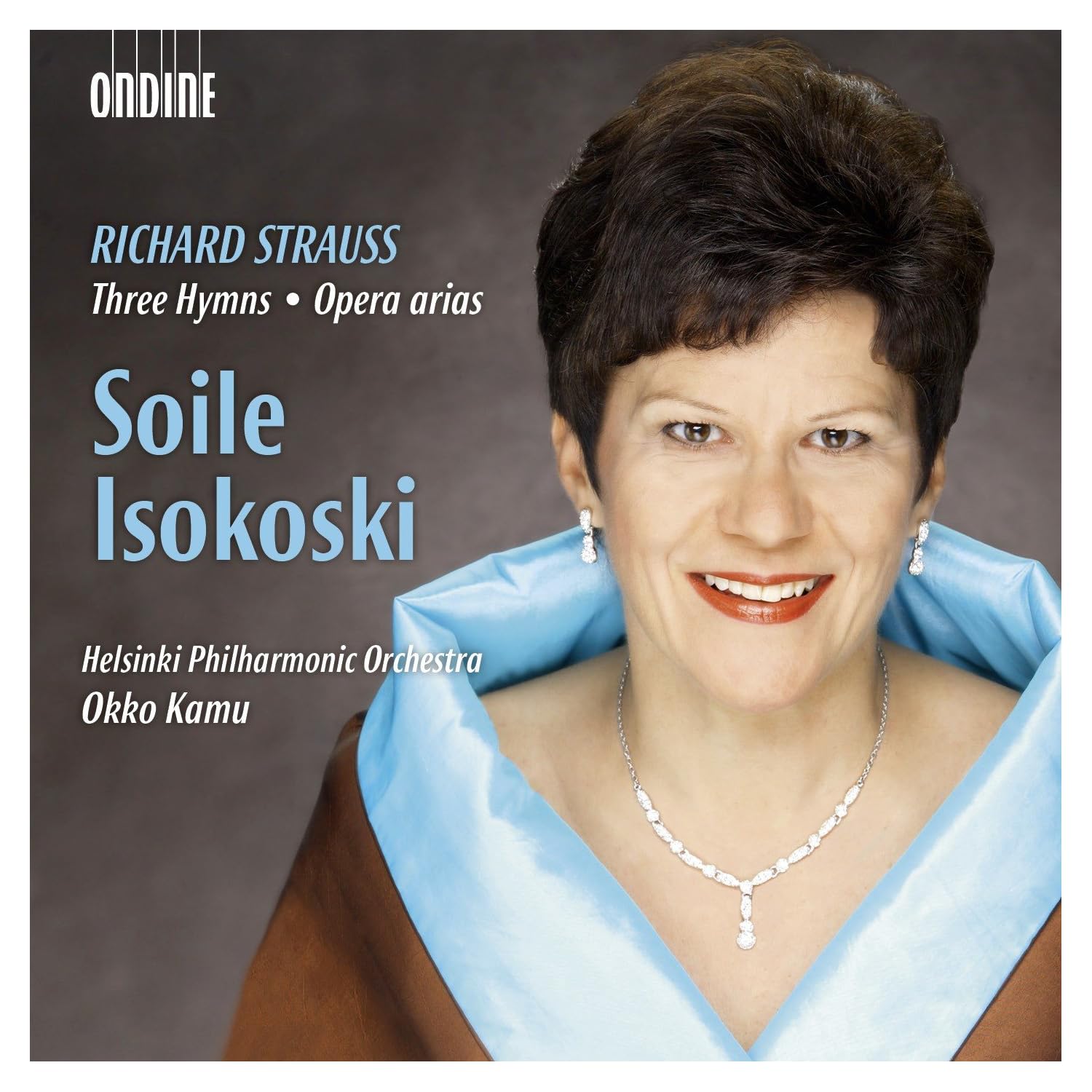
CD Review: Isokoski sings Strauss

Ondine
Soile Isokoski

3 Hymns - Opera Arias Helsinki Philharmonic Orchestra, Okko Kamu


Soile Isokoski's decade old recording of the Four Last Songs was rightly heralded by the critics at the time as a major new release - a voice of shimmering beauty in pristine condition giving a radiantly pure reading of the autumnal (yet evergreen) song cycle, along with a wide selection of other orchestral songs, most still relatively rare in the concert hall, presented with the most advantageous advocacy from singer and orchestra.

So how does this follow up fare? The focus this time is far more on operatic repertoire and we have excerpts from Der Rosenkavalier, Ariadne and Capriccio, along with the rarely heard Three Holderlin Hymns. The ultra silvery brightness and delicacy to the sound is still there, and the formidable technique still fully in evidence, though the vibrato has subtly widened, and there isn't that last degree of ease and fluency that was so appealing in the last record. Still, there are few sopranos around who are singing like this at the moment, so one cant complain too much in this regard.

What I do have issues with is the lack of commitment to characterisation. The blankness of her portrayals, a kind of anti-expressionismo, where an "instrumental" sound is almost always preferred to meaningful response to the text, simply will not do in Strauss of all composers, whose marriage of word and music is probably the tightest of any composer. (Wagner marries text and sound very closely too of course and is Strauss' principal influence along with Schubert and Schumann, but Strauss outdoes them all for specificity of colour on each word in a phrase.) Occasionally Isokoski will shade the line such as the moment of self mockery when the Marschallin imagines herself as "Die alte frau ... Die alte furstin Resi". But then in "Die Zeit, die ist ein sonderbar' Ding", she might be singing about anything and it is a million miles from the whispered moment of realisation and quiet despair that Strauss has so movingly composed for the Marschallin. The extent to which she ignores not just the text, but the emotional tenor of this music is almost wilful and borders on the bizarre. Is she not moved by the beautiful music at least, if not by words? In the last Strauss recording she made, this bland, uncommitted quality came across as a sort of floating radiant purity, unusual in Strauss singing where the beauty of the music, and arching, aching phrases are often or even usually suggestive of rather more carnal activity. But it's not enough here.

That the language is not a priority for her is again reflected in her German which rarely sounds truly idiomatic, and occasionally is just plain bad - "Mashmal steh ich auf, mitten in die Nacht". "Der aufgeblasni schlichte Kerl". Very surprising especially considering how often she sings this role, but also the fact that this is a studio recording, where these things are so easily rectified.

Isokoski is singing Ariadne at Glyndebourne next summer. Glyndebourne being a small house makes it the perfect venue for her to sing this role, which is at least one vocal category too big for her really. As I noted before when I saw Fleming's debut in this role earlier this year, my preference is for a silvery, lyric sound in this part (see: Schwarzkopf, Della Casa), though that doesn't mean that the low tessitura can be ignored. Isokoski lacks the chest resonance that this role ideally calls upon (which conversely is surely part of the reason for her vocal longevity), but she does sing very beautifully in the high lying phrases, and she can get away with less characterisation as Ariadne is not the four dimensional character that the Marschallin is. Still there are textual problems ("Stilla Gott"), and vocal shading seems incidental rather than chosen to match the music and text.

The final scene of Capriccio, one of Strauss' finest inspirations, is again beautifully sung, Isokoski giving full thrift to the huge arcs of melody, never once sounding strained, and from a purely singing perspective she is most successful here of the operatic excerpts. But once again, the lack of attention to the text means it isn't as moving as it should be. I won't go on about it.

The orchestral songs fare better. It almost goes without saying that operatic characterisation is very different from interpreting a song. The former is about creating and developing a believable, fully rounded character, the latter about presenting a poem in heightened form and communicating its ideas. Naturally, the same technical and interpretive skills are used in each but with a subtly different order of priorities. Some singers can do both superlatively, some can do one and not the other, and some can do neither, despite having a wonderful voice!

The Three Holderlin Hymns of 1921 are not top drawer Strauss, though they do point the way towards the "late" Strauss (which wasn't to emerge fully for another 2 decades) in their ecstatic soprano soaring against a softly shifting, fundamentally rather plain, though magically glowing orchestral background. There are many wonderful moments to cherish (not least the beginning of the second hymn, Ruckkehr in die Heimat, and the closing minutes of Die Liebe), though by this stage in his life, Strauss' finest song writing was mainly behind him and they lack the freshness, spontaneity and originality of his earlier orchestral songs. After his relentless exploration of presenting the text in his contemporaneous opera Intermezzo, Strauss takes a break here word painting wise, and he just lets the soprano sing on and on. This suits Isokoski just fine, and she finally recalls the lovelyness of her previous Strauss recording, seeming much more in her element, not just interpretively, but technically too, the voice ideally matched to the surging orchestral canvass.

The playing of the Helsinki Philharmonic Orchestra is mostly fine, accurate and detailed, though occasionally there is a little slackness, and Okko Kamu's direction lacks forward momentum and drive. This is not a matter of speed - things are on the brisk side even, especially in the Ariadne excerpts, but somehow the internal tensions of the music have to drive the music forward, and there's rarely a feeling of that here outside of the songs.

-------------------------------------------------------------------------------------------------------

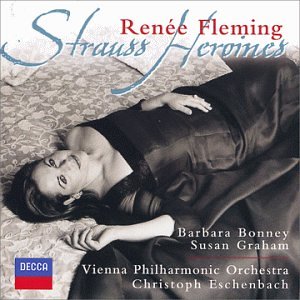
I don't want to seem like a one track reviewer, but this is my blog and so I will indulge myself. This CD made me return once more to Fleming's Strauss Heroines CD, and once again I simply marvel at the artistry. In it's prime in the late 1990s, Fleming had an even more beautiful instrument than Isokoski's, just gleaming and glowing with overtones, and a better technique that is even freer to sing every phrase exactly as the singer wants. But most importantly we get the sense that in German repertoire at least, she is an interpretive artist of the highest calibre and stature: her pointing of text and line is endlessly nuanced, her selection of vocal colours and timbres, emotions and mood always apt and can change on a knife edge, every word matters, yet almost miraculously she never gets in the way of the line, the legato absolutely exquisite and apparently endless. She knows when Strauss wants the voice to bloom and when to hold back, and these are portrayals of the utmost feeling and depth in every parameter. Bonney and Graham are ideal partners, and the Vienna Philharmonic with Eschenbach at the reigns make one of the most glorious sounds ever committed to disc.


Wednesday, 1 August 2012

Rosenkavalier take 2 with Renée Fleming in Munich

31/7/2012

Just as in her Baden Baden Ariadnes earlier this year, Renée seemed freer vocally on her second outing and was much better in her Act I monologue, with her trademark superb legato and sense of line returning in a much more natural and verbally unexaggerated portrait. In Act III she was back to the very parlando style of the previous night.

At the beginning of Act III, it was announced that Sophie Koch was quite unwell and would continue but couldn't sing anymore. She had given very fine performances of Acts I and II and I couldn't have told that anything was wrong. For the Mariandel scenes she spoke the lines, and then the production's Annina, Heike Grotzinger heroically filled in for the Octavian parts as Koch continued to act it. Given that it was such short notice Grotzinger did very well, but obviously it was sad not to be able to hear Koch's voice in the trio. I hope Koch makes a speedy recovery. It was quite informative to see Octavian's Act III dialogue spoken as it was usually still audible- you realised how lightly orchestrated his music is, and that this really is a lyric part despite it never sounding unimpressive. Strauss is the master. Sometimes Koch would just leave out a line, especially with the Marschallin, just bowing her head, and the emotion was still conveyed. Very interesting.

In the shop afterwards I saw the first copies of a new CD release of the 2009 Fleming/Koch/Damrau/Hawlata/Kaufmann/Thielemann Baden Baden Rosenkavalier that is being released elsewhere at the beginning of September. This'll be the same as the beautiful DVD version, which has fabulous orchestral playing, Fleming in strong form, and Kaufmann as the tenor!

I realised soon after posting the last review that I had entirely forgotten to write about the production's Faninal - Martin Gantner. Inexcusable, but isn't this always Faninal's lot? One of the most difficult, if not the most difficult of all Strauss' baritone roles, and the most thankless. Gantner was vocally incredibly solid, singing the role as if it presented no challenge whatsoever. I was quite impressed! Acting wise he didn't feel like a fully developed character, but I think this is partly the fault of the production which doesn't give him a very strong profile.

In the end I felt rather unmoved at the end of this evening. Whether it was because I was so far from the stage, or because of the problems in Act III I couldn't tell, but I think at least part of it is I find all the grandiose stage krammerei and crinolines slightly alienating and distracting from the essentially extremely intimate and small scale story. For many people precisely these stage features are a huge draw. Your mileage may vary. For me opera should never be about escapism though - it should be about learning to connect more deeply with yourself, other people and the world around you.

Monday, 30 July 2012

Rosenkavalier with Renée Fleming in Munich

28/07/2012

Nice to see one of the classic Rosenkavalier productions in the flesh, and I have to say that this is probably the best "traditional" Rosenkavalier that I have seen. No prizes for guessing which kitsch fest productions I'm referring to in the review (linked to below) when I say that it's better than them. I personally am not the biggest fan of traditional with regards to Strauss - though his music is very evocative of action, tension and drama, I just don't think it is ever truly evocative of the era that he is setting it in. For me, Rosenkavalier, Elektra, Arabella and Capriccio all suffer in some way or another if presented in entirely "traditional" stagings with no degree of abstraction. I'd like to write about this at greater length at some point, so will leave it there for the time being.

The real point of this Rosenkavalier was surely as an outing for Fleming's Marschallin. She was MUCH better here vocally than in her recent London/LSO concert - more comfortable and giving more sound. Acting wise, this was not as moving as the wonderful Baden Baden DVD, where she seems quite on the edge and gives one of the most brilliant performances of her career, but this Munich performance was also not as terribly self conscious and indulgent as the last Met outing. She responds best to very detailed direction I think, but she knows this role so well that she has many ideas of her own that she can bring - as I mention in the review, some of them were just so brilliantly done, that I really felt quite misty eyed at the end of Act I.

This production/performance was the first time that Act II and III didn't drag for me, and actually it was Act I that one felt the lull - Ochs long section between the bed scene and the entry of all the other characters - just too much stillness and posey mooning around from all of them.

I was talking to Zerbinetta about Strauss, and about what my favourite stagings were... I found it hard to give an answer - I very much like the Carsen Capriccio, and the Baden Baden (originally Paris) Rosenkavalier mentioned above, and feel the old trick of updating a piece to the time the composer wrote it is particularly apposite for Strauss as he seems to be so much a man of the zeitgeist intellectually and artistically. I do very often think Strauss operas need rescuing from certain aspects of tradition and they are extremely hard to do well because they are so dense and so complex. This shouldn't be a bad thing though! Zerbinetta said that she thought Strauss was in some ways unstagable - the music is so choreographed, so detailed, so rich, that you couldn't hope to represent it all on stage, and I think that is very interesting and probably true. Textually too, Hofmannsthal's librettos are hopelessly, wonderfully dense and complex, which is both a blessing and curse. This is another reason I prefer some level of abstraction in Strauss - it allows us to hear the music more clearly and actually focus on the glittering orchestral canvas, rather than getting lost in the fuss and trinketry that so often clouds the visual field in traditional Strauss stagings... oops, said I'd talk about this later. Anyway.


I reviewed it for Bachtrack: http://www.bachtrack.com/review-bayerische-staatsoper-rosenkavalier-schenk-fleming

Here's a taste:

Renée Fleming is probably the most sought-after Marschallin of her generation and this is a role that still fits her like a glove, both vocally and temperamentally. She is now 53, and though there is no question that she can still sing every note of this part, the peerless control and breathtaking radiance of the sound that that earned her the nickname "The Beautiful Voice" is sadly now much diminished.
...Acting-wise, this was not the most poised or regal Marschallin that I have seen from Fleming, but there were certain details in the characterisation that rang heartbreakingly true...

Monday, 16 July 2012

Renée Fleming with Gergiev and the LSO

15/07/2012

A rather disheartening way to end the season for me. The two orchestral showpieces on offer, Debussy's La Mer, and Stravinsky's Petrushka were perfectly acceptably played (the LSO rarely plays truly badly) but both felt a bit by rote, and Gergiev didn't offer anything particularly personal with either of them. I must admit that I've never seen the LSO be as responsive or play with as much energy with Gergiev as I have seen with Previn or Colin Davis. I found out recently from personal anecdotes that they feel very affectionately towards both Previn and Davis, so I wonder whether there is just a fundamental personality mismatch with Gergiev. Difficult to know if I've just caught a lot of off nights, or whether there's something in this...

The main draw of the evening was surely Renée Fleming, who sang two French song cycles that she has recently also recorded. My comments on the pieces and a review of that disc can be found here. She started with Dutilleux's song cycle Le Temps L'horlage, a poignant and quirky song cycle about time and yearning (shades of the Marschallin, Rusalka?) written especially for her. This is not a cycle that allows for much vocal display until the last song, and this was a softly shaded reading aiming mostly at text. Though always just about audible, Fleming was just hardly giving out any sound, and her trade mark endless legato seemed compromised and hard fought for. The lower notes occasionally became quite unstable timbrally and occasionally also with regards to intonation, traditionally also strengths. The last song at least brought some more fortitude in the voice, but never for sustained periods. Lacking in the voice now is the extraordinary vibrancy and beauty of timbre that it used to have, and also its rock steady technical security; all the time we feel strongly that she is shepherding her resources. She fared slightly better in Ravel Shéhérezade, but again this was a very small scale reading, and it just sounds like a completely different voice from the one it used to be. Very sad. She was quite good in her Ariadne's earlier this year, but I am now worried for her Munich Rosenkavaliers that I will be attending.

It pains me to write this because I really do believe that Fleming is the greatest singer of her generation, and certainly she is the singer (along with Callas) who has given me more listening pleasure than any other. She has talked throughout her career of the mystery of the voice, how it can just leave a singer in a very short time, and about early retirement and knowing when to retire. She has been very careful and prudent with repertoire selection for this reason, to keep the voice young and avoid damage at all costs, but age catches up with everyone sooner or later. I am sure she is only too aware of her current vocal condition, but I imagine it is much harder to actually stop singing than talk about it - emotionally, psychologically and not least financially.  Farewell dates at the Royal Opera House are being mooted for the 2016-2017 season (when she'll be 58) but I wonder how much voice will be left by then and I wonder also whether these next few years of singing will damage her legacy. Leontyne Price was still singing with unbelievable beauty at 58 (see here), but every soprano is very different - it doesn't just come down to careful vocal management, but also to genetics, hormones, mental health, self confidence, luck, and innumerable other factors.

Ultimately I can only express my unending gratitude to Renée Fleming for her voice and artistry, mercifully captured for posterity on so many wonderful recordings, which have afforded me so many hours of extraordinary pleasure. Beauty is a very fragile and ephemeral thing and one must be supremely grateful for the times it touches our lives and the ability it has to lift us above the mundane and into the numinous.

Wednesday, 14 March 2012

Renée Fleming - Poèmes Review


But first a bit of a gloss on Fleming and French music. The review starts in paragraph five.

I am an adoree of Fleming's voice and art - I have pretty much everything she's ever recorded and like or love most things, though am not totally without criticism (no singer is perfect). At some point I'll do a recording career retrospective of her, but for the time being, suffice it to say, that along with Callas, she is my favourite vocal artist of the recorded era.

Fleming has always said that she enjoys singing in French the most because of how it feels to sing with its resonance in the mask and particular tonal characteristics. Her previous Massenet recordings bear this out - the refulgent fullness and unbelievable beauty of her recordings of this repertoire show her to be completely in her element - the pure joy of singing is absolutely palpable in every phrase she sings in these operas. Manon and Thais are particularly challenging roles, requiring first and foremost an immaculate timbral beauty, very good support, flexibility and evenness in all three registers (they stay very low and go very high), effortless pianissimo singing, a lot of stamina and also a dramatic power in the climaxes. Fleming is maybe the only singer of the last twenty-five years who has done full justice to these roles - of the two other famous current Manons, Dessay does not have the low register or timbral beauty, and Netrebko lacks the requisite control and finesse.

Here's her studio Thais:

And a live Manon:


Her other major french roles that she essayed were Micaëla in Carmen (which every young lyric soprano has surely sung), Charpentier's Louise and Marguerite in Gounod's Faust. She has recorded arias from all three. Louise she only did once in San Francisco, but dropped the role because the character was not interesting to her. It's available as a bootleg. Marguerite also didn't appeal to her - the character was too much of a victim. It's available to hear on the Met player. Although again both roles demand the utmost vocal finesse, ideal in some ways for Fleming, one suspects that she was slightly overparted in both roles - usually they are spinto territory. She did received rave reviews for both however.

Here's a live performance of the famous aria from Louise. The most perfect pianissimo singing since Caballé and just listen to that messa di voce at the end:


Why not Debussy's Pelléas et Mélisande? It's not a very glamorous role, but with her verbal acuity and beauty of tone one wonders whether it might have been an opportunity missed. Certainly her Debussy songs on her Night Songs disc are absolutely ravishing, particularly the Chansons de Bilitis where she captures the languid eroticism and sexual tension so perfectly.

So far we have only discussed 19th century French opera. This brings us to the current disc. No opera arias here, Fleming has chosen to record three French song cycles, all written after 1900. The first is Ravel's Shéhérazade, his first masterpiece, a fin-de-siecle, soft-porn evocation of the orient, replete with rippling chords, harmonies sweet and spiced, the orchestra a plush divan above which the liquid enchantments of the soprano's vocal line unfurl.

This piece would seem to be ideal for Fleming, who is a mistress of the yearning eroticism of this period of music - indeed she previously released an album devoted to just that. But Fleming no longer has the extraordinary vocal beauty she had a decade ago, or even five years ago, as is to be expected of a soprano of her age (she is now 53), and her top especially now sounds rather dry. We began to hear this in her two previous discs: a bit in her second Four Last Songs recording, and a bit more in the Verismo album, though both were still gorgeous. But here, it really is not as it once was. The low range at least is almost as rich as it ever was, her juicy chest register one of her specialities, though the notes don't quite come with as much force as before. For the first time in her career we hear occasional very mild pitch problems and an unevenness in the vibrato towards the end of a phrase when the breath is running out - again, aspects of singing which she was traditionally been virtually faultless in. (EDIT: this has just appeared on youtube: http://www.youtube.com/watch?v=Of8B8xhE-jI her singing the same piece in her prime. Unfortunately there's blips in the recording, but the difference in vocal quality is noticeable)

Fleming has sung this piece quite a few times in the last 5 years or so. It lies rather low and is often taken on by mezzos, and with its non extreme vocal demands one feels that Fleming will be singing this a lot in the coming years. For similar reasons I think we'll be getting quite a few Rückert-Lieder from her.

Things get better in the Messiaen. His Poemes pour Mi are rather early (composed four years into his first marriage), but sound "late" somehow - the skeletal harshness of the orchestration sounds like an etiolation of his middle period rather than a warm up to it, and to an extent the harmony sounds like a clichéed, by wrote, version of middle Messiaen rather than an exploration of his newly discovered harmonic palette. It's not one of his greatest works, though does contain portions of extraordinary beauty and intimacy. Traditionally this piece has been sung by dramatic sopranos, and it does really need a larger voice than Fleming's to do it full justice - the orchestration is rather heavy on the brass front for a start, and the declamation is often very dramatic. But the voice also needs to be focused and pure, which is where Fleming has the upper hand - especially in the more lyric Book II. Her wonderful legato comes into its own here - in L'Epouse the voice is smooth as satin and we almost hear the Fleming of old.

copyright Decca

Finest of all are the Dutilleux selections. This recording of Le Temps L'horlage has in fact already been released in a very small run on an obscure in house label, so I have lived with it for a couple of years already. It's a recording of the world premiere performance of the full work that was originally broadcast on the radio. The piece was written for Fleming over a number of years because Dutilleux was and is an admirer of hers. According to wikipedia he said: "I constantly thought of her voice's character, of her power of lyrical expression".

Initially I have to say I didn't much like it, thinking it was very minor Dutilleux - I adore many of his earlier works (above all the two concertos and the string quartet) but this seemed to be saying nothing particularly new or extraordinary, and I didn't think that he had much talent for vocal writing. But the more I listened the more I realised how charming it is as a piece, and how beautiful some of the phrases really are - and since it was recorded in 2009, Fleming is in much better voice, especially her top. It's still less beautiful than her true prime, but certainly noticeably better than in the Ravel. The piece is largely what we've come to expect from Dutilleux - a shimmering, shifting, brooding impressionistic dreamscape reminiscent of the lushest and darkest aspects of Debussy and Ravel, but far less tonal, less permanent sounding, every bit as sensuous as these two at its frequent best. Le Masque is particularly beautiful with its string clusters and desolate muted brass, and Fleming's wide ranging vocal line floats, drifts and soars through the haze. The word setting is particularly beautiful here, and Fleming really savours the text and line. The more unsettled feel of Le Dernier Poeme, with its novel accordian, gives way to an interlude scored only for cellos and at the end harpsichord (the orchestra employed in this piece is very large). The final song Envirez-vous ("Get drunk") returns to the ravishing strangeness of Le Masque, but then wanders and jerks about, until the epic and spell binding climactic phrase: la vague, l'oiseau, l'horloge, vous repondront: "Il est 'l'heure de s'ennivrer" (...and the wind, the wave, the bird, the clock will tell you: "it's time to get drunk!") which sails and flies before the open eyed wonder and humour of the end.

Also included are two early Sonnets which were specially orchestrated for this album, and the second is just gorgeous. Nice to find an unknown jewel like this in an album, and Fleming, being a stickler for obscure repertoire seems to make sure that each album has one.

On this disc orchestral support is very fine, the darkly shifting tissues of sound of the new Dutilleux artfully conjured by Seiji Ozawa and the Orchestre National de France. Alan Gilbert is almost as good in the rest of the disc with Orchestra Philharmonique de France, though the sound might not have recessed the orchestra quite so much. But it all sounds authentic and the orchestra is more than capable of following Fleming's lead in expressively milking every last languorous phrase.


Fleming's reviews have not started mentioning the lessening of beauty of The Beautiful Voice yet, so maybe people are still hearing what they want to hear, but sadly for those of us who know and love this wonderful instrument of Fleming's, she is now in the autumn of her prime. I'll be seeing her sing the Dutilleux and the Ravel with Gergiev and the LSO in the summer.